

IRS Enforcement Revenue Fell to $93.8 Billion in 2025
Taxpayers paid a record amount to the IRS in fiscal year 2025, but the amount collected through enforcement moved in the opposite direction.
According to a new report from the Treasury Inspector General for Tax Administration (TIGTA), taxpayers paid approximately $5.3 trillion in federal taxes in fiscal year 2025. That was up 4.2% from fiscal year 2024 and 13.2% from fiscal year 2023. It was also the most tax revenue ever paid to the IRS, though TIGTA notes that the figure is not adjusted for inflation. Adjusting roughly for inflation takes some of the shine off that record: consumer prices rose about 5.7% over 2024 and 2025, so the 13.2% increase in tax collections amounts to about a 7% increase in inflation-adjusted terms.
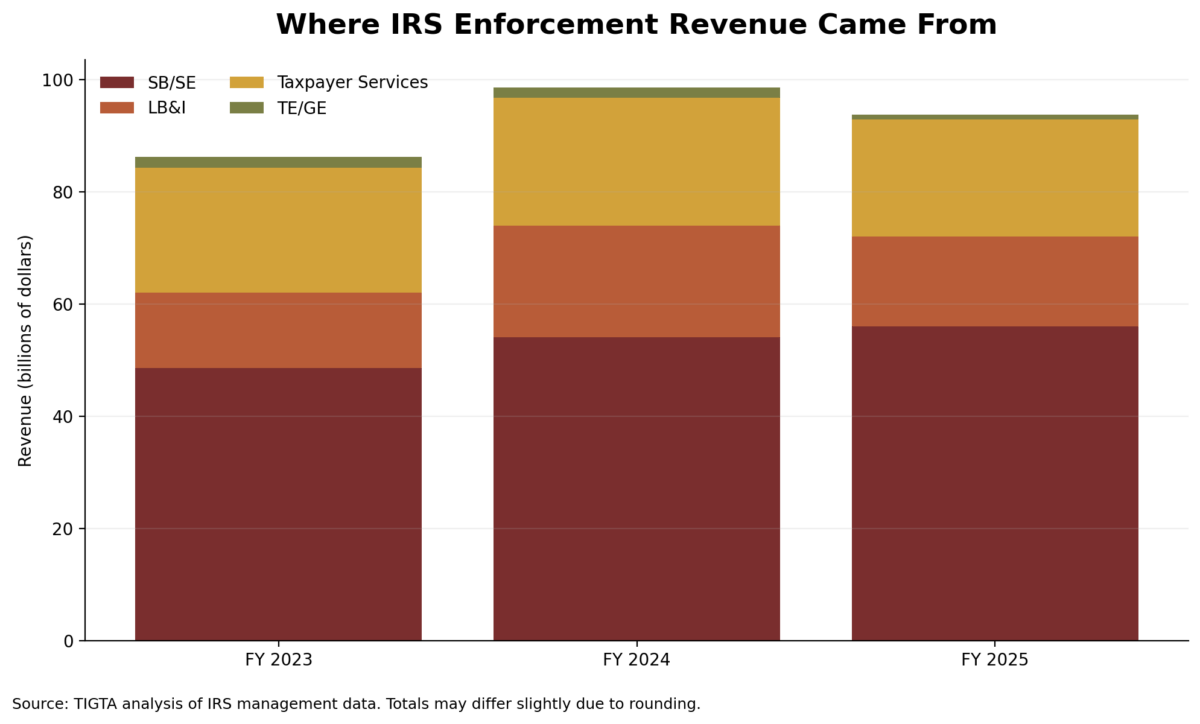
Overall, IRS enforcement activities generated $86.1 billion in fiscal year 2023 and climbed to a record $98.7 billion in fiscal year 2024. In fiscal year 2025, however, enforcement revenue slipped to $93.8 billion—a decline of about 5%. While enforcement revenue remained about 9% higher than in fiscal year 2023 in nominal dollars, the inflation-adjusted increase was only about 3%.e
Collection Is Doing Much Of The Heavy Lifting
Not all IRS enforcement is the same. TIGTA breaks enforcement revenue into four categories: Examination, Appeals, Collection, and the Automated Underreporter (AUR) program.
- Examination (sometimes shortened to “Exam”) generally reflects revenue resulting from audits of tax returns.
- Appeals reflects revenue associated with cases resolved through the IRS’s independent administrative appeals process.
- Collection is money brought in through efforts to collect taxes that have already been assessed but remain unpaid.
- AUR is essentially the IRS’s document-matching operation. It compares information that taxpayers report on their returns with information the IRS receives from employers, banks, brokers, and other third parties (such as Forms W-2 or 1099). When the numbers don’t match, the IRS may propose an adjustment, typically through a CP2000 notice.
In fiscal year 2025, Collection accounted for $81.8 billion of the IRS’s $93.8 billion in enforcement revenue—or 87% of the total. By comparison, Collection accounted for 81% of enforcement revenue in fiscal year 2023.
Collection revenue increased from $69.8 billion in fiscal year 2023 to $82.1 billion in fiscal year 2024, then ticked down slightly to $81.8 billion in fiscal year 2025.
Examination revenue climbed from $7.1 billion in fiscal year 2023 to $10 billion in fiscal year 2024, then fell 35% to $6.5 billion in fiscal year 2025. Appeals revenue fell from $5.1 billion to $1.5 billion over the three-year period, while revenue attributed to AUR dipped from $4 billion to $3.9 billion.
One reason that Collection has been able to up its numbers? The IRS turned the notices back on. During and after the pandemic, the IRS paused several automated collection notices. In February 2024, it restarted several of those programs, including certain balance-due notices, notices of intent to levy, and notices to taxpayers who had failed to file returns. TIGTA says revenue from automated collection notices jumped nearly 12% in fiscal year 2024 following the restart.
That’s important context when considering the IRS’s overall enforcement numbers. Collecting a tax liability the IRS already knows is due is different from finding income or tax that hasn’t been reported.
What About The Tax Gap?
Often, when we think about missing tax dollars, the focus is on the gross Tax Gap—the difference between taxes owed and taxes paid voluntarily and on time. The Tax Gap is actually an estimate since much of it reflects tax the IRS doesn’t know was owed. The agency uses audit results, administrative data, and statistical modeling to measure noncompliance. That means that numbers also lag by several years because some data—particularly information about underreporting—aren’t available until examinations are completed.
The IRS projects a gross Tax Gap at $696 billion for tax year 2022. Most taxpayers likely assume that the Tax Gap is largely attributable to taxpayers who simply don’t pay what they owe. But that’s not the case. Of that $696 billion, $539 billion is the result of underreporting, while $94 billion is due to underpayment ($63 billion is the result of taxpayers failing to file returns).
Underreporting means that a taxpayer filed a return but reported less tax than was actually owed. That can include omitted or understated income, overstated deductions or credits, and other errors that reduce tax liability. In other words, more than three-quarters of the Tax Gap—about 77%—is attributable to underreporting, while underpayment accounts for about 14%.
However, Collection activities accounted for 84% of all enforcement revenue between fiscal years 2023 and 2025. TIGTA highlights this mismatch, suggesting that the IRS could have a greater impact on underreporting by increasing enforcement.
Audits Are Moving In The Other Direction
The amount of additional tax proposed following IRS examinations has declined for two consecutive years. The proposed additional tax fell from $31.9 billion in fiscal year 2023 to $29 billion in fiscal year 2024 and to $26.8 billion in fiscal year 2025.
The decline was concentrated in field examinations. Proposed additional taxes from those examinations dropped from $24.1 billion in 2023 to $19.1 billion in 2025. Correspondence examinations moved in the opposite direction in 2025, increasing from $6 billion to $7.7 billion.
The number of individual examinations started also dropped sharply. In fiscal year 2024, the IRS started approximately 58,000 examinations of individuals reporting total positive income over $400,000 and about 329,000 examinations of individuals at or below that level. By fiscal year 2025, those numbers had fallen to approximately 43,000 and 264,000, respectively. Overall, individual examination starts fell 30% from 2024 to 2025, while starts involving taxpayers reporting more than $400,000 in total positive income fell 27%.
The IRS entered fiscal year 2024 with additional funding and an explicit strategy to focus enforcement resources on high-income taxpayers and complex returns. TIGTA’s data show that, in fiscal year 2024, examinations involving taxpayers reporting more than $400,000 in total positive income jumped from roughly 35,000 in fiscal year 2023 to 58,000, even as examinations below that threshold declined. Both categories then fell in 2025.
What Happened To The IRS Workforce?
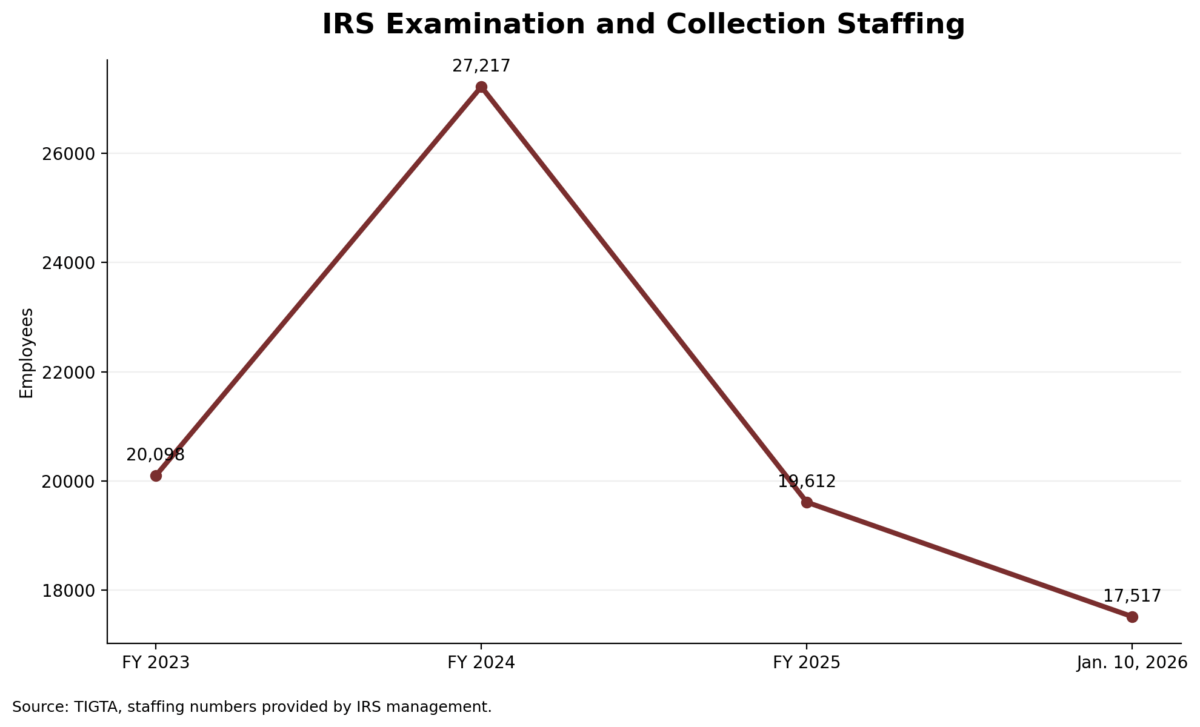
IRS staffing numbers help explain the shift. At the end of fiscal year 2023, the IRS had 20,098 employees in Examination and Collection. After a hiring surge, that number rose to 27,217 in fiscal year 2024. By the end of fiscal year 2025, it had fallen to 19,612—a 27% one-year decline.
By January 10, 2026, combined Examination and Collection staffing stood at just 17,517. That means that, after the hiring push of 2023 and 2024, the IRS entered 2026 with fewer Examination and Collection employees than it had at the end of fiscal year 2023.
Taxpayers and tax professionals didn’t need TIGTA’s report to know that the workforce reductions were being felt inside the IRS. But the report puts some numbers behind that disruption. Small Business/Self-Employed officials told TIGTA that examination starts were paused from March 2025 through the end of the fiscal year due to uncertainty about available resources. Large Business and International officials similarly reported that staffing changes affected audit activities.
Large Partnerships Stand Out
One of the goals of the IRS’s Inflation Reduction Act (IRA) enforcement funding was to improve compliance among large corporations and partnerships. These examinations tend to be more complex and resource-intensive than, say, plain-vanilla document matches for individuals, making staffing and training particularly important.
The numbers, however, show a sharp decline in partnership examination starts. The IRS started 6,709 partnership examinations in fiscal year 2023. That fell to 2,285 in fiscal year 2024 and just 1,589 in fiscal year 2025—a 76% decline in two years. TIGTA says several factors contributed to the decline, including an IRS reorganization, shifting staff, training delays, and, eventually, the 2025 workforce reductions.
Some Numbers Require A Little Caution
On paper, some IRS employees appeared more productive in fiscal year 2025.
The Automated Collection System collected about $14.1 billion with 2,857 employees, compared with $12.7 billion with 4,828 employees a year earlier. Collections per employee jumped 88%, from more than $2.6 million to more than $4.9 million.
Field Collection showed a similar pattern. Revenue officers collected approximately $8.2 billion in fiscal year 2025, compared with $5 billion the previous year, even as their numbers fell from 3,418 to 2,544.
But TIGTA cautions against interpreting those figures as a straightforward productivity gain. The increase likely reflects a combination of additional revenue from the restart of collection notices and staffing levels measured at year-end, after significant reductions had already occurred. In other words, fewer employees didn’t necessarily lead to higher revenue. They may simply have been left at the end of a pipeline that had already been filled.
What Happens Next?
IRS enforcement doesn’t happen in real time. TIGTA notes that examinations started in one fiscal year can take years to close, so changes in budgets and staffing may not immediately appear in enforcement revenue.
Finances have changed again. The IRS’s annual appropriation remained at $12.3 billion from fiscal years 2023 through 2025, supplemented by IRA funds. But the agency exhausted its supplemental IRA enforcement funding as of December 31, 2025. Now, estimated enforcement spending for fiscal year 2026 is $5.1 billion, 29% below the $7.2 billion actually spent in fiscal year 2025.
TIGTA cautions that while workforce reductions influenced the fiscal year 2025 numbers, their downstream effects “are likely to become more apparent over time.”
That makes fiscal year 2025 something of a transition year: current enforcement revenue still reflects programs restarted and resources added in earlier years, while examination starts and staffing levels point toward what may come next. Whether the decline from 2024’s record enforcement haul is a one-year dip or the beginning of a longer trend won’t be clear for some time.




Want more Taxgirl?
Get tax news, explainers, deadlines, and more delivered straight to your inbox.
Subscribe →