

Social Security Benefits Will Rise 3.6% In 2027. Here’s What That Means For You
Millions of Americans will see bigger Social Security checks in 2027. The Social Security Administration (SSA) announced a 3.6% cost-of-living adjustment (COLA) for next year, which could mean an extra $75 a month for the average retired worker.
But the annual announcement isn’t just about retirement benefits. The adjustment also affects disability and survivor benefits, Supplemental Security Income (SSI), and several other Social Security thresholds. For people who are still working, another number to watch is the maximum amount of earnings subject to Social Security tax, which is also increasing.
Here’s what you need to know.
How Much Will My Social Security Benefits Increase In 2027?
The 3.6% COLA will take effect for Social Security benefits payable in January 2027. Nearly 72 million Social Security beneficiaries will receive the increase.
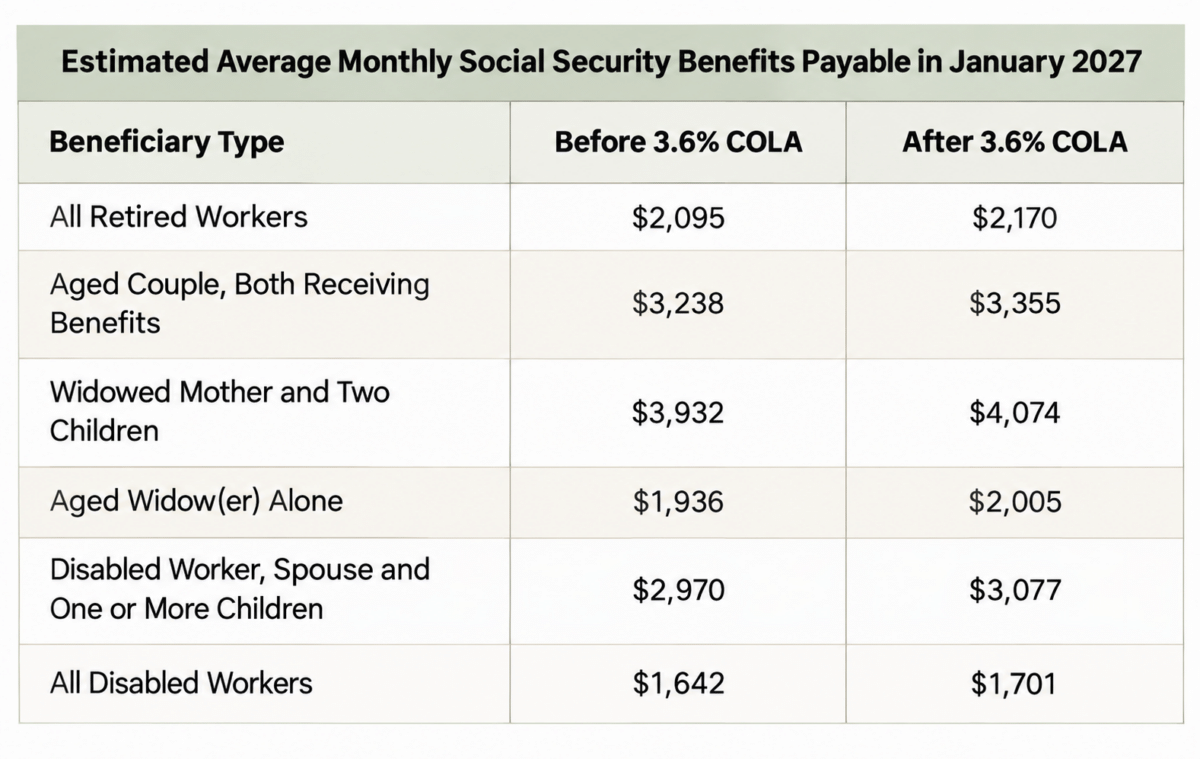
Monthly benefits are expected to rise for the average retired worker from $2,095 to $2,170, an increase of about $75 per month, or $900 over the course of the year. For an older couple who are both receiving benefits, the estimated combined monthly payment will increase from $3,238 to $3,355, or an additional $117 per month.
If you receive Social Security Disability Insurance (SSDI) or survivor benefits, you’ll also see an increase. The amount will vary because the COLA applies to each person’s benefit. Someone receiving a larger monthly benefit will generally see a larger dollar increase than someone receiving a smaller payment.
Why Do Social Security Benefits Increase?
Social Security’s annual COLA is intended to help benefits keep pace with inflation. Without periodic adjustments, the purchasing power of a fixed monthly benefit would decline as the cost of everyday goods and services rises.
Federal law ties the COLA to changes in the Consumer Price Index for Urban Wage Earners and Clerical Workers (CPI-W), as calculated by the Bureau of Labor Statistics. SSA compares the average CPI-W for July, August, and September with the average for the same period in the last year a COLA became effective. For 2027, that means comparing the third quarter of 2026 with the third quarter of 2025, producing a 3.6% increase.
Will I Actually See The Full Increase?
You won’t necessarily pocket the entire increase. For beneficiaries who are enrolled in Medicare, Part B premiums are typically deducted directly from Social Security payments. If premiums go up in 2027, that increase could offset part of the COLA.
And premiums are expected to go up. According to the 2026 Medicare Trustees Report, the standard monthly Part B premium is projected to increase from $202.90 in 2026 to $209.50 in 2027, an increase of $6.60 per month. The 2027 figure is a projection, not a final premium amount. The official 2027 premiums will be announced separately.
What About Federal Income Taxes?
Depending on your other income and filing status, up to 85% of your Social Security benefits may be included in federal taxable income. Importantly, the federal income thresholds that determine whether Social Security benefits are taxable are not automatically adjusted for inflation. That means that as benefits go up, you may find that a larger share of your Social Security income becomes taxable, even if your other income hasn’t changed significantly.
That doesn’t necessarily mean you’ll owe more in federal income taxes. Eligible taxpayers age 65 and older may also qualify for an enhanced senior deduction of up to $6,000 per person, subject to income limitations. The temporary deduction, available for tax years 2025 through 2028, is sometimes called “no tax on Social Security,” but it doesn’t change how Social Security benefits are taxed. It may, however, reduce your overall tax bill.
The Social Security Wage Base Is Increasing, Too
For workers and employers, one of the most significant changes in 2027 is the increase in the Social Security taxable wage base. In 2026, Social Security taxes apply to the first $184,500 of covered earnings. In 2027, that amount will rise to $192,300, a $7,800 increase in earnings that may be subject to Social Security tax.
Unlike the COLA, which is based on changes in consumer prices, the Social Security taxable wage base is adjusted based on changes in national average wages.
How much do you pay in tax? Employees pay 6.2% in Social Security tax, and employers pay a matching 6.2%. Self-employed individuals generally pay both portions, for a combined Social Security tax rate of 12.4%, subject to applicable adjustments and deductions.
For an employee earning at least the new wage base in both years, the increase could mean as much as $483.60 in additional employee Social Security tax in 2027 compared with 2026. Self-employed taxpayers with sufficient could see an increase of up to $967.20 in the Social Security portion of their self-employment tax.
(For more on how Social Security works, check out this previous article.)
Medicare taxes work differently. There is no wage cap on the 1.45% employee Medicare tax, and the additional 0.9% Medicare tax continues to apply to wages and self-employment income above specified thresholds.
What If I’m Collecting Social Security And Still Working?
You can work while receiving Social Security retirement benefits, but if you haven’t reached full retirement age, earning too much can temporarily reduce your payments. In 2027, the annual earnings limit for beneficiaries under full retirement age will increase to $25,560 for the entire year, up from $24,480 in 2026. If you exceed that limit, SSA generally withholds $1 in benefits for every $2 earned above the threshold.
A higher limit applies in the year you reach full retirement age. For 2027, that limit is $67,920, up from $65,160 in 2026. SSA generally withholds $1 for every $3 earned above that threshold, but only counts earnings before the month you reach full retirement age.
What counts when figuring the amount? The earnings test generally applies to wages and net earnings from self-employment, not pensions or investment income.
Fortunately, once you reach full retirement age, the earnings limit disappears. And benefits withheld under the earnings test aren’t necessarily lost forever, since SSA recalculates your monthly benefit at full retirement age to credit months in which benefits were withheld.
What About Disability Benefits And SSI?
The COLA also affects people receiving disability benefits and SSI, even though the programs have different eligibility requirements and rules. For example, unlike Social Security retirement and disability benefits, SSI benefits aren’t subject to federal income tax.
For Social Security disability, the substantial gainful activity (SGA) threshold will rise to $1,770 per month for non-blind individuals in 2027, up from $1,690 in 2026. The threshold for blind individuals will increase to $2,950 per month. The trial work period earnings threshold will also rise, from $1,210 to $1,270 per month.
For SSI recipients, the maximum federal monthly payment will increase to $1,029 for an eligible individual and $1,544 for an eligible couple. Actual payments can vary based on income, living arrangements, and state supplements.
While the Social Security retirement and disability benefit increases will appear in payments beginning in January 2027, the higher SSI payments will begin on December 31, 2026.
When Will I Find Out My New Benefit Amount?
SSA will begin making personalized COLA notices available through the online my Social Security accounts in late November. If you want to receive your notices electronically, you must have an account and enroll in paperless notices by November 18. If you haven’t enrolled in paperless notices, you will receive your notice by mail in December.
The notice will show your updated benefit amount, payment information, and applicable deductions. Medicare premium information for 2027 will also become available as those amounts are finalized.
Looking for more info? You can create or access your account at ssa.gov/myaccount.




Want more Taxgirl?
Get tax news, explainers, deadlines, and more delivered straight to your inbox.
Subscribe →