
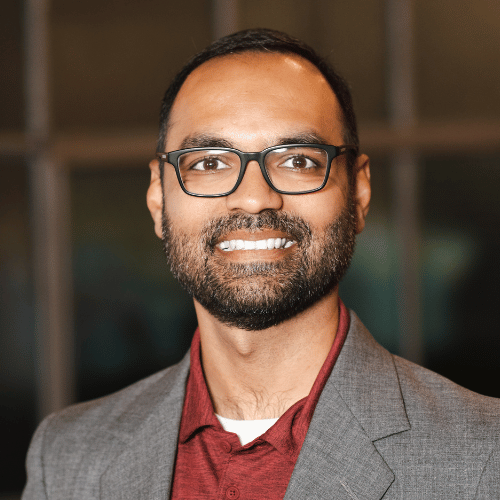
Getting to Know You Tuesday: Bijal Chikani
It’s Getting to Know You Tuesday!
Bijal Chikani, CPA, has spent more than 20 years helping ultra-high-net-worth families make sense of the ever-changing—and rarely simple—world of taxes. As Co-Director of National Tax Practice and Strategy at Crescent Grove Advisors, he enjoys tackling complex tax challenges, finding practical solutions, and, most importantly, building lasting relationships with clients and colleagues.
Originally from India and now based in Lake Forest, Illinois, Bijal firmly believes great work starts with great people. He enjoys mentoring the next generation of tax professionals, sharing what he’s learned along the way, and bringing positive energy and a collaborative spirit to the team.
When he’s not thinking about taxes (yes, it does happen!), Bijal loves sports, traveling, discovering new cuisines, spending time outdoors, and making memories with his family. Whether it’s solving a complicated tax question or planning the next adventure, he’s always up for a new challenge
So, let’s get to know Bijal.
In His Own Words
1. Where are you right now? At my office in Lake Forest, Illinois – probably not too far from a tax return or a tax question!
2. What’s your official title, and what do you actually do? I’m Co-Director of National Tax Practice and Strategy at Crescent Grove Advisors – definitely a lot of words! In simple terms, I help oversee the firm’s tax practice, make sure our clients stay tax-compliant, and help them plan ahead rather than just look backward. I also spend a lot of time working through complex tax issues for ultra-high-net-worth families and supporting our tax team.
3. Where did you go to school, and what did you study? I earned my undergraduate degree from Gujarat University in Ahmedabad, India, where I studied accounting and management. I later earned a master’s degree in taxation, completed the Intermediate level of the Chartered Accountancy program through the Institute of Chartered Accountants of India, and became a licensed CPA.
4. How did you end up in tax? I’ve always been drawn to the ever-changing world of taxes. It combines numbers, research, problem-solving, and strategy – and there is always something new to learn. More than 20 years later, that constant change is still what keeps it interesting.
5. What was your first real job? At a small local CPA firm while I was studying for the CPA exam. It gave me hands-on experience early and a strong foundation in both the technical side of tax and client service.
6. What’s one thing people might be surprised to learn about you? I can whistle to tunes pretty well! It’s one of those small things that tends to surprise people – and I’m usually happy to prove it when challenged.
7. If you weren’t working in tax, what would you be doing? Probably something involving yoga and travel. I learned yoga when I was young, and I’m trying to make it a more consistent part of my routine again, so I could definitely see myself teaching it. And since I love traveling and experiencing new places and cultures, doing something that combined both would be pretty ideal.
8. What’s the best piece of tax, money, or career advice you’ve ever received? Start investing early, invest often, and stay consistent. Compounding can make an incredible difference over time. Time and consistency can be just as powerful as the amount you invest.
9. What tax issue do you think is getting too much attention right now? The latest ‘hot’ tax strategy. There’s always a new idea getting attention, but not every strategy is right for every family. I’d rather focus on what actually fits the client’s goals and circumstances.
10. What tax issue isn’t getting enough attention? Tax planning around major life events. A business sale, retirement, inheritance, relocation, or large charitable gift can have significant tax consequences that are much easier to manage when you plan ahead.
11. What’s the biggest tax myth you’d like to bust? That every tax deduction is automatically a good financial decision. ‘It’s tax deductible’ doesn’t mean it’s free. The tax benefit should be part of the decision, not the reason for the decision.
12. What’s a tax question you wish people would ask you more often? I’d like people to ask, “How does this decision affect my family’s overall financial plan?” I like that question because it moves the conversation beyond just taxes and gets us thinking about the bigger picture. The best tax strategy should complement your broader financial goals, not be viewed in isolation.
13. What’s one tax rule you would change if you could? I’d simplify the rules around retirement accounts. Between contribution limits, required distributions, Roth rules, rollovers, and income thresholds, something that should encourage long-term saving can become unnecessarily complicated.
14. What’s one non-tech thing in your office that you couldn’t do without? My QuickFinder. Even with all the technology and research tools available today, I still reach for it regularly. Sometimes it’s simply faster to grab the book – and after using it for so many years, I know exactly where to look.
15. Which tech tool, platform, or software do you rely on most in your practice? Tax research platforms. Tax laws are constantly changing, so having reliable research tools at your fingertips is essential. They help me get to the underlying authority quickly, but knowing how to interpret and apply it to a client’s situation is still the most important part.
16. What’s the best use of AI in tax or tax practice? Making good tax professionals better and more efficient. AI can help organize information, accelerate research, analyze data, and reduce repetitive work. But based on my personal experience, AI is still learning and adapting, so its output needs to be reviewed and validated. If it gives us more time for strategy, judgment, and clients, that’s where I see the real value.
17. What are you watching right now (streaming or otherwise)? I’m a Chicago Bears fan, so I’m gearing up for NFL season! I also just started watching Severance.
18. Coffee or tea? Is Masala chai an option? If so, Masala chai – no question.
19. Pancakes or waffles? Waffles for me – but my kids tell me I make really good pancakes, so apparently I’m on Team Pancake when I’m the one cooking!
20. If you received an unexpected tax refund tomorrow, what would you do with it? First, I’d want to know why! A large unexpected refund probably means we could have planned better during the year – I’d rather have that money working for me than waiting to get it back. If it’s a small refund, I’d put some toward the future and use the rest for a fun experience with my family, probably involving travel.
You can find out more about Bijal on the firm’s website and on LinkedIn.
About Getting to Know You
If you’d like to recommend a tax pro to be featured, send your suggestions to gtky (at) taxgirl (dot) com with the subject: Getting to Know You Tuesday. Self-nominations are totally okay, and encouraged! If you’ve previously submitted a nomination, please feel free to send it again. I’ll consider all submissions, even those that were selected, so long as they were more than three years ago.