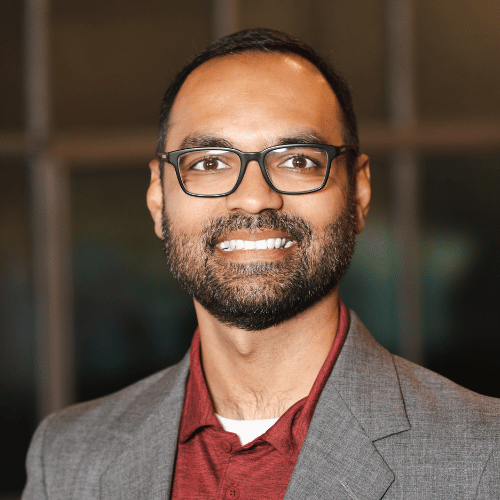

Getting To Know You Tuesday: Benjamin Alarie
Ben Alarie has spent much of his career thinking about how the law works—and how technology might make it work better. A professor at the University of Toronto and co-founder and CEO of Blue J, Ben was interested in artificial intelligence long before it became part of nearly every conversation in the tax profession. What began as a university research collaboration in 2015 has grown into a company serving more than 6,000 organizations worldwide. But for Ben, the goal isn’t to replace tax professionals. It’s to give them better tools to do their jobs, while recognizing that good judgment still matters.
There’s plenty more to Ben than AI and tax law. He clerked at the Supreme Court of Canada, has written books exploring the future of legal reasoning, and once spent four years hiking more than 900 kilometers of the Bruce Trail with his family. He meditates every day, keeps a hammock in his office, and doesn’t watch television. This week, he talks about the mentor who sparked his interest in tax, why firms should be paying attention to how their employees use AI, and what he’d change about a tax system full of unnecessary pitfalls.
So, let’s get to know Ben.
In His Own Words
1. Where are you right now? Toronto, Canada
2. What’s your official title, and what do you actually do? I am the CEO and co-founder of Blue J. Practically, that means I’m responsible for setting the long-term vision of the company and ensuring we execute against it, as we build the AI reshaping tax. Because we operate in a high-stakes domain, “CEO” for me is about intellectual integrity as much as it is about growth metrics. We’re building AI that professionals rely on to advise clients on decisions that have a real impact on their businesses and personal lives. My role is to make sure we scale that technology responsibly, by staying deeply anchored in the needs of tax professionals.
3. Where did you go to school, and what did you study? I got my bachelor’s in economics from Wilfrid Laurier University, a JD from the University of Toronto, a master’s in economics from the University of Toronto, and an LL.M. from Yale Law School.
4. How did you end up in tax? When I was at the University of Toronto, I had a mentor named David Duff who taught me about income tax law. I took an interest in the policy and philosophical problems, and how much tax touches everything. We spent more than a decade together co-authoring the second through sixth editions of Canadian Income Tax Law (LexisNexis), which was a big part of the inspiration for building a solution like Blue J.
5. What was your first real job? My first real job after my education was as a law clerk at the Supreme Court of Canada for the Honourable Madam Justice Louise Arbour.
6. What’s one thing people might be surprised to learn about you? I’m married to my high school sweetheart, Khrista. During the pandemic lockdowns, our family of four, along with Khrista’s dad, Tom, started hiking the Bruce Trail on weekends. It became a family bonding project. Over about four years, we hiked the whole thing: 900-plus kilometers. We finished up in Tobermory over Thanksgiving weekend last October. I also meditate every day without fail (sometimes four or five sessions in a day). I started in 2016, shortly after founding Blue J, and haven’t missed a day in years.
7. If you weren’t working in tax, what would you be doing? I’d be an economist-philosopher. I’ve always been drawn to the work of taking something enormously complex and making it legible, testable, and useful. Tax law is really applied philosophy in a lot of ways: it encodes values, distributes burdens, shapes behaviour, and forces you to reckon with the trade-offs inherent in our shared empirical reality that don’t have ready, clean answers. What I love about building Blue J is that it’s essentially an applied philosophy project. We’re taking the messy, layered logic of tax systems and asking whether we can make them more transparent and predictable. If I weren’t doing this, I’d want to be doing the same thing in a university setting, writing about how complex tax and legal systems actually work and how people can reason through them more clearly. That’s essentially what I’ve been doing with The Legal Singularity (University of Toronto Press, 2023) and Superjustice (Oxford University Press, 2026), so in a way I’m already doing it on the side.
8. What’s the best piece of tax, money, or career advice you’ve ever received? To understand incentives. Tax law, and financial decision-making more broadly, are ultimately about incentives and trade-offs. When you understand how incentives are structured, you can usually predict behavior and outcomes more clearly. On a more practical level: think long term. Compounding applies to knowledge, relationships, reputation, and capital.
9. What tax issue do you think is getting too much attention right now? Whether AI is going to replace tax professionals. It’s the people with real expertise who get the most out of these tools, because they already know how tax works and what their clients need. When you actually look at the effect of AI on the tax profession, it’s augmenting professionals, not replacing them.
10. What tax issue isn’t getting enough attention? Shadow adoption of AI in tax. A lot of tax professionals are using AI without their firm’s knowledge. In our survey with CPA.com this year, 80% of practitioners said they use AI weekly or monthly, but only 60% work for firms that have formally adopted it. That gap means that at a lot of firms, client work is going through tools nobody has vetted. Firms need to realize that they’re not choosing between AI or no AI. They’re choosing between sanctioned AI use and unsanctioned AI use.
11. What’s the biggest tax myth you’d like to bust? That AI is inherently bad for accounting firms because most bill by the hour. It’s not wrong to say that firms are facing a pricing paradox, with AI making tax work faster, but most of them still earn revenue from time. But this doesn’t need to be the case. The billable hour has been a mainstay in accounting for decades, but it’s not an inevitability. With AI making tax work faster, firms are finally starting to look to alternative revenue models that work with AI—rather than against it. With these alternative models in place, firms can fully garner the economic benefits of AI.
12. What’s a tax question you wish people would ask you more often? How do you know your answer is right?” For a long time the standard was to walk down the hall, describe the situation to the smartest person in the office, and repeat that two or three times until you felt comfortable. I think in 20 years people will be amazed we gave advice that way. We talk a lot about how to teach judgment with our Academic Access program, and the reality is there’s a much more systematic way you can go about discerning answer accuracy.
13. What’s one tax rule you would change if you could? I’d make it pitfall-free. The complexity of the Internal Revenue Code and the Canadian Income Tax Act imposes costs on people who are just trying to comply. Many taxpayers end up doing things that lead them to pay more tax than they would otherwise have to if they had been well-advised. A huge share of the $500 billion spent annually on global tax administration is just the overhead of navigating around unfair and hidden pitfalls that don’t need to exist. Building traps (intentional or not) into tax systems to collect more from the unwary is distasteful. A lot of it is sediment, which is accumulated patches and carve-outs that nobody has had the will to clear. I’d start clearing the sediment, defusing the traps, and improving the tax system’s coherence.
14. What’s one non-tech thing in your office that you couldn’t do without? My hammock. There’s a colourful hammock in my office. Some people swear by standing desks; I’ve gone in the other direction.
15. Which tech tool, platform, or software do you rely on most in your practice? It may sound predictable, but it’s AI itself. I use generative AI constantly to test ideas, stress-test arguments, explore alternative framings, and pressure-test assumptions. It’s like having an always-available research assistant who never gets tired. But the key is verification. In tax, every conclusion needs grounding in trusted sources. So the combination of AI plus trusted primary and secondary materials is indispensable.
16. What’s the best use of AI in tax or tax practice? Right now, I’d say taking the grind out of research while keeping every answer traceable. Tax has a known universe of authority, meaning the code, regs, case law, rulings, and commentary. AI can now work across all of it and give you an answer linked back to the sources, so you can check where it came from. I spent thousands of hours doing that research by hand as an academic, and it still feels a little like magic. Looking to the future, there’s a lot of tax work that AI will be able to take on that will leave way more time for practitioners to focus on the work that deeply requires their expert judgment.
17. What are you watching right now (streaming or otherwise)? Nothing, actually. I don’t watch TV or stream anything, which makes me a very poor source of recommendations.
18. Coffee or tea? Coffee.
19. Pancakes or waffles? Pancakes.
20. If you received an unexpected tax refund tomorrow, what would you do with it? It may sound unusual, but I’d take the family somewhere new to walk. We just finished hiking the entire Bruce Trail, 900-plus kilometres over four years, so we’re overdue for a new project. After that, I’d put the rest back into Blue J’s mission. We’re making Blue J available for free to low-income taxpayer clinics across the U.S. and Canada, and to students in law and accounting programs. The next generation of tax professionals needs to learn how to work with the best new tooling, not just read about it. And this clinical and academic access has the nice byproduct of mitigating against exactly the kind of pitfalls in the tax system that so often bite the least advantaged. That’s worth funding.
You can find out more about Ben on his website and view his profile on LinkedIn. You can find out more about Blue J on the company’s website and view the company’s profile on LinkedIn.
About Getting to Know You
If you’d like to recommend a tax pro to be featured, send your suggestions to gtky (at) taxgirl (dot) com with the subject: Getting to Know You Tuesday. Self-nominations are totally okay and encouraged! If you’ve submitted a nomination before, feel free to send it again. I’ll consider all submissions, even those that were selected, so long as they were more than three years ago.




Want more Taxgirl?
Get tax news, explainers, deadlines, and more delivered straight to your inbox.
Subscribe →