
What’s Line 11 on Form 1040? Understanding Adjusted Gross Income (AGI)
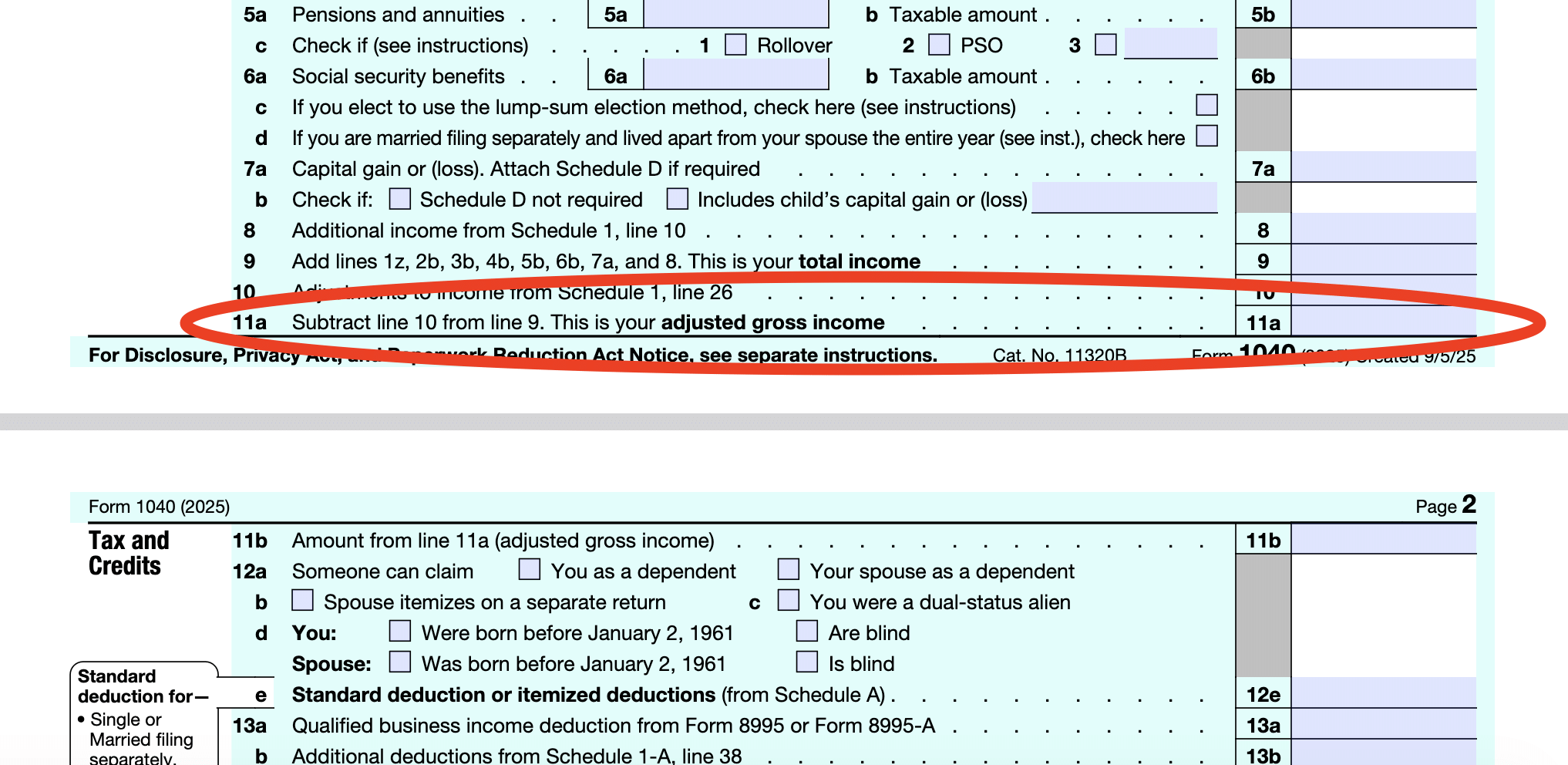
Whether you’re filling out forms for credit checks, FAFSA, or other financial applications, you may be asked about your adjusted gross income, or AGI. For years, you would find AGI on line 11. On the current Form 1040, you’ll find AGI on Line 11a at the bottom of the first page. (And, assuming no changes, the draft Form 1040 indicates you’ll find AGI on Line 11a in 2026, too.)
AGI is one of the more important numbers on your tax return. It starts with the income you report for the year and subtracts certain adjustments allowed by the tax code. Your AGI can affect your eligibility for deductions, credits, and other tax benefits, and you may need your prior-year AGI when you electronically file your next tax return.
Here’s what it means, how you get there, and why it matters.
What Is Adjusted Gross Income?
Adjusted gross income is generally your total income for tax purposes, reduced by certain adjustments to income.
In its simplest form: Total income − adjustments to income = adjusted gross income (AGI)
Total income can include wages, salaries, tips, interest, dividends, capital gains, retirement income, business income, and other taxable income. On Form 1040, you combine those amounts to arrive at total income on Line 9.
But total income isn’t necessarily your AGI. Before you get there, you may be able to subtract certain adjustments.
What Adjustments Reduce AGI?
Adjustments to income are sometimes called “above-the-line” deductions because you claim them in arriving at AGI. You don’t have to itemize deductions to claim them.
Depending on your circumstances, adjustments may include amounts for:
- The deductible portion of self-employment tax
- Certain contributions to retirement accounts
- Health savings account (HSA) contributions
- Student loan interest
- Certain self-employed health insurance costs
- Certain educator expenses
Many of these adjustments are calculated on Schedule 1, Additional Income and Adjustments to Income. The total is then carried to Form 1040.
Not every taxpayer will have adjustments. If you don’t, your total income and AGI may be the same.
AGI Is Not the Same as Taxable Income
This is where taxpayers can get tripped up. Your AGI is not necessarily the amount of income on which you’ll pay federal income tax. You still have a few adjustments to make.
After calculating AGI, you generally subtract your standard deduction or itemized deductions, along with any other applicable deductions, to arrive at taxable income. For example, the new deductions for seniors, tips, overtime, and car loan interest that took effect in 2025 are claimed after you calculate AGI. The same will be true of the new charitable deduction for non-itemizers, which takes effect in 2026.
That means you could qualify for one or more of those deductions and reduce your taxable income without changing the AGI reported on Line 11a.
Those deductions will, however, change your taxable income, which showed up in 2025 on line 15.
Why Does AGI Matter?
AGI isn’t simply a subtotal on the way to calculating your tax. It’s used throughout the tax code.
Your AGI can affect whether you qualify for certain deductions and credits, as well as whether those tax benefits are reduced or eliminated as your income increases. It can also factor into calculations and limitations involving medical expenses, charitable contributions, retirement savings, and other tax provisions.
And sometimes the tax code doesn’t use AGI at all. Instead, it uses modified adjusted gross income, or MAGI.
What’s the Difference Between AGI and MAGI?
MAGI generally starts with AGI and then modifies that number—often by adding back certain deductions or exclusions.
If that sounds a little like I’m hedging, I am. That’s because there isn’t a single universal MAGI calculation. Different provisions of the tax code can define modified adjusted gross income differently (of course they do, this is tax law, after all). That means the MAGI calculation used to determine eligibility for one tax benefit may not match the calculation used for another.
So, if a tax rule refers to MAGI, don’t assume the number on Line 11a is automatically the one you need. Check the rules for that particular tax provision.
Why Do I Need Last Year’s AGI?
There’s another reason taxpayers often go hunting for AGI: electronic filing.
When you e-file your federal income tax return, you may be asked for your prior-year AGI as part of the IRS authentication process. In that case, you need the AGI from the prior-year return, not the AGI you’re calculating on the return you’re filing now.
If you have a copy of last year’s return, look for adjusted gross income on that year’s Form 1040. Since line numbers can change, it’s better to look for the description rather than assume AGI will always appear on the same line.
If you don’t have a copy of your prior-year return, you may be able to find the information on an IRS tax transcript. You can view your transcript online with an IRS online account (I recommend everyone sign up for one—here’s how).
The Bottom Line
You may not spend much time thinking about AGI after you file your return, but the tax code does. It shows up again and again in rules governing deductions, credits, contribution limits, and other tax benefits. Knowing where to find it—and what went into calculating it—can make the rest of your tax return a little easier to understand.
And if you remember AGI being on Line 11 rather than Line 11a, your memory is fine. The form changed. The underlying concept didn’t.