

IRS Mileage Rates Changed Midyear: What To Know Before Year-End
If you use your car for business, medical care, charitable work, or a qualifying move, now is a good time to check your mileage records.
That’s especially true this year. The IRS changed its standard mileage rates in the middle of 2026, which means taxpayers may need to use two different rates when calculating deductions or reimbursements for the year.
Here are the rates you’ll need for 2026:
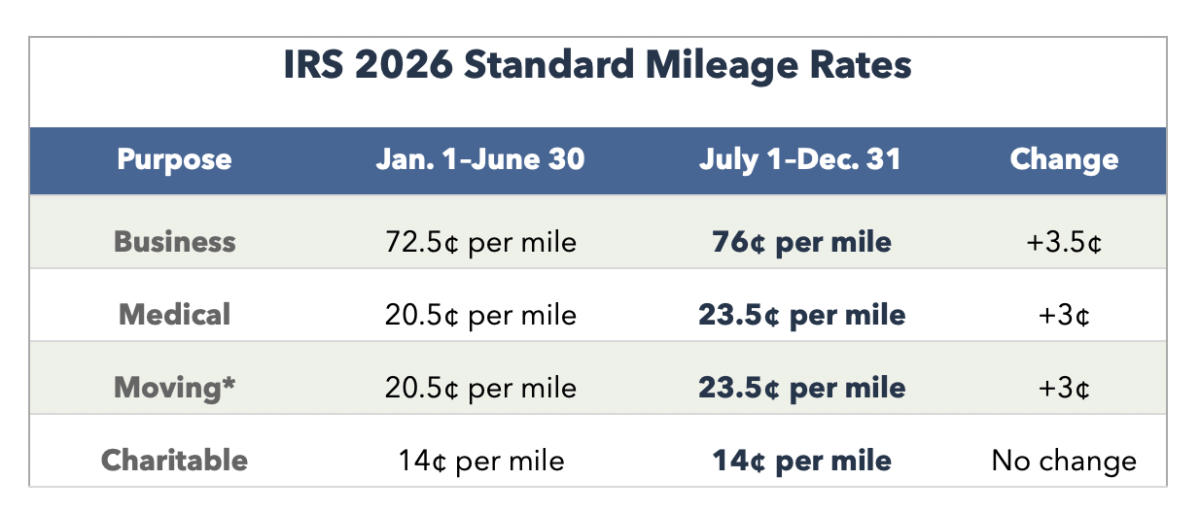
* The moving rate is available only for qualifying moves by eligible active-duty members of the Armed Forces and, beginning in 2026, certain members of the intelligence community.
The revised rates apply to eligible transportation expenses paid or incurred on or after July 1, 2026. The rates announced for 2026 continue to apply to expenses paid or incurred from January 1 through June 30.
In other words, the date matters this year. If you’ve been tracking mileage without separating trips by date—or if you’ve fallen a little behind on your mileage log—now is a good time to get those records in order.
Why Did The IRS Change The Rates Midyear?
The IRS ordinarily sets the optional standard mileage rates before the beginning of the tax year. But this year, the agency made a rare midyear adjustment in response to increased fuel prices.
According to AAA, the national average for a gallon of regular gasoline was $2.82 in early January 2026. By late June, it had climbed to $3.92 per gallon. As of late September, the national average was about $4.49 per gallon.
The IRS last made a midyear mileage-rate adjustment in 2022, after gasoline prices surged following Russia’s invasion of Ukraine.
How Do The Standard Mileage Rates Work?
Standard mileage rates offer taxpayers a simplified way to calculate certain deductible vehicle expenses. It’s typically straightforward math for taxpayers: you multiply the number of qualifying miles driven by the applicable rate.
The IRS doesn’t calculate all rates the same way, which is why the medical and moving rates differ from the business rate. The business rate is based on an annual study of both fixed and variable costs of operating an automobile, including depreciation, insurance, repairs, tires, maintenance, gas, and oil. The medical and moving rates are based on variable operating costs.
The charitable rate is different: it’s set by statute at 14 cents per mile and has not changed since 1998. If the rate had kept pace with inflation, it would be about 29 cents per mile.
How Do You Use The Mileage Rates In 2026?
For 2026, you’ll need to know not only how many qualifying miles you drove, but when you drove them:
- Use the original rate for qualifying mileage from January 1 through June 30.
- Use the revised rate for qualifying mileage from July 1 through December 31.
For example, suppose you drive 10,000 qualifying business miles during 2026, with 5,000 from January through June and another 5,000 from July through December. The standard mileage amount would be:
- 5,000 miles × 72.5 cents = $3,625
- 5,000 miles × 76 cents = $3,800
That’s a total of $7,425 before accounting for other deductible vehicle expenses, such as qualifying business parking fees and tolls.
Do I Have to Use the Standard Mileage Rate?
The standard mileage rate is optional. Taxpayers who qualify may instead calculate the actual costs of operating the vehicle, though that generally requires more detailed recordkeeping.
If you own a vehicle and want to use the standard mileage rate for business purposes, you generally must choose that method in the first year the vehicle is available for business use. In later years, you can generally switch between the standard mileage rate and actual expenses.
For a leased vehicle, if you choose the standard mileage rate, you generally must continue using it for the entire lease period, including renewals.
Are All Miles Driven Deductible?
Putting miles on your car doesn’t automatically make them deductible. Personal mileage generally isn’t deductible. Commuting—the cost of traveling between your home and your regular workplace—is generally considered personal, even if you’re doing work-related activities during the trip.
Business mileage may be deductible for self-employed taxpayers and other qualifying taxpayers. Most employees, however, cannot deduct unreimbursed employee business mileage on their federal income tax returns. That’s because the Tax Cuts and Jobs Act (TCJA) temporarily suspended miscellaneous itemized deductions subject to the 2% adjusted gross income floor beginning in 2018. The One Big Beautiful Bill Act (OBBBA) made that disallowance permanent.
There are exceptions. Members of a reserve component of the Armed Forces, qualified performing artists, and state or local government officials paid in whole or in part on a fee basis may still be able to deduct qualifying unreimbursed employee business expenses as an adjustment to income.
What About Medical Mileage?
Taxpayers who itemize deductions on Schedule A may include qualifying transportation costs as part of their deductible medical expenses. This can include mileage for trips primarily for and essential to medical care. For 2026, the rate is 20.5 cents per mile for qualifying miles driven through June 30 and 23.5 cents per mile beginning July 1.
Keep in mind that medical expenses are deductible only to the extent that your total qualifying expenses exceed 7.5% of adjusted gross income (AGI). For example, if your AGI is $50,000, you can deduct only medical expenses that exceed the $3,750 floor ($50,000 x 7.5%). So if your medical expenses totaled just $3,500, you can’t deduct any of them. If they totaled $4,000, you can deduct $250 ($4,000 of expenses less the $3,750 floor).
What About Charitable Mileage?
If you use your vehicle while performing services for a qualified charitable organization, you may be able to deduct qualifying mileage at 14 cents per mile. For example, if you drove 1,000 miles for charitable service, you could claim a charitable deduction of $140 (1,000 x .14).
As with medical mileage, you must itemize deductions on Schedule A to claim a charitable contribution deduction for mileage. The new deduction for non-itemizers beginning in 2026 applies only to qualifying cash contributions, not mileage.
What About Employer Reimbursements?
Employers can also use the mileage rates to reimburse employees for business use of their personal vehicles.
The midyear change matters here, too. The revised rates apply when the mileage allowance is paid to the employee on or after July 1, 2026, and the related transportation expense is paid or incurred on or after July 1. For the revised rate to apply to an employer mileage allowance, both the allowance and the underlying transportation expense must fall on or after July 1.
This makes employer reimbursement policies particularly important, since most employees can’t claim a federal deduction for unreimbursed business mileage.
What Should I Do Now?
Before year-end, check your mileage records. This is the part worth doing now rather than waiting until you’re preparing your tax return.
You need adequate records to substantiate qualifying mileage. Those records should generally show:
- The date of each trip.
- The number of miles driven.
- Your starting point and destination.
- The business, medical, moving, or charitable purpose of the trip.
If you use a personal vehicle for both business and personal purposes, you’ll also need to separate the two. A mileage-tracking app can make this easier, but it isn’t required. A contemporaneous mileage log, spreadsheet, or other reliable record can work, too.
For 2026, there’s one additional detail you don’t want to overlook: ensure your records distinguish miles driven before July 1 from those driven on or after July 1. If you’ve fallen behind on your mileage log, now is a much better time to reconstruct those records than when you’re preparing your return next April.
Remember that the standard mileage rate is a shortcut for calculating certain vehicle expenses, not a shortcut around the recordkeeping rules. As always, keep excellent records, including those showing when, where, how far, and why you drove.
Where Can I Find More Information?
The IRS originally announced the 2026 standard mileage rates in Notice 2026-10. It modified the business, medical, and moving rates in Announcement 2026-11, effective July 1, 2026.