

I Timed 188 Calls to the IRS. Here’s Where the Time Actually Went.
Everyone who has called the IRS has a story about being on hold. I wanted an actual figure instead of a story. So from June 9 to September 25, 2026, I recorded every working call I placed to the IRS and timed it. There were 188 of them.
These were ordinary calls, the kind I make every week as an enrolled agent, a tax professional licensed by the IRS to represent taxpayers. Most went to the Practitioner Priority Service line, the phone line for tax pros calling about clients who have signed a Form 2848 (Power of Attorney). Think of it as a permission slip that lets me talk to the IRS about someone else’s account. On the calls, I was pulling transcripts (the IRS record of an account), checking balances, or setting up payment plans. Real work, for real people.
Each of my call recordings is transcribed with timestamps. Any silence of 30 seconds or longer counted as waiting. Short silences did not count, so every waiting figure here is a little smaller than the truth.
Where 92 Hours Went
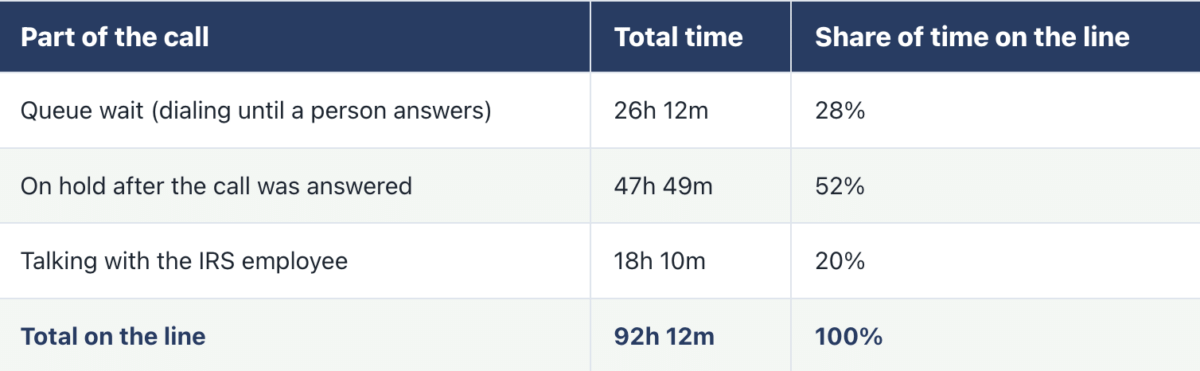
Add up all 188 calls, and I spent 92 hours on the line with the IRS this summer. That is more than two full work weeks. About 74 of those hours were waiting. For every minute I actually spoke with someone, I waited four.
What surprised me was where the waiting happened. I expected the front door to be the problem, the long stretch of music before anyone answers. It wasn’t. The bigger wait came after someone picked up.
Picture a deli counter. You take a number and wait your turn. That’s the queue. Then you reach the counter, place your order, and the person behind it walks into the back to find what you asked for. You stand there. On my calls, that second wait took nearly twice as long as the first.
Getting through was usually quick. Half my answered calls reached a person in under two minutes. But one in ten sat in the queue for more than half an hour, and the worst took an hour and 45 minutes, on September 11. Another one in five never connected at all.
Once someone did pick up, the average call ran 36 minutes. About seven minutes of that was conversation.
What the Hold is For
I want to be fair to the IRS employees on the other end. In my transcripts, the hold after pickup is almost always the employee going to look something up: pulling an account transcript, finding a payment, or confirming a figure before saying it out loud. It is like a librarian who walks into the stacks to get the book you asked for instead of guessing at what is in it. Slow, but I would rather have it done right.
But the wait is still time taken away from actual tax work, and it fell heaviest at the end of summer.
I broke the answered calls down by month. In June, the average queue wait was 14 minutes, and the average hold during the call was 17. July was the easy month: three minutes in the queue, 10 on hold. August crept back up, with seven minutes in the queue and 19 on hold. September was 28 minutes in the queue and 40 minutes on hold.
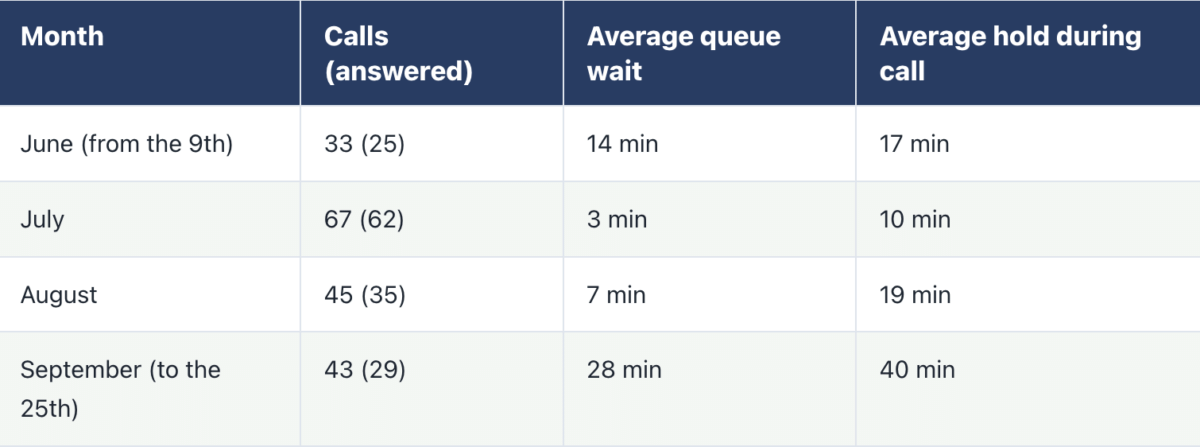
On September’s averages, a single answered call ran about 77 minutes: 28 minutes waiting for a person, 40 minutes on hold once I had one, and nine minutes of talking. Four of my six longest queue waits landed in September. In July, no single week of mine topped two hours of queue time. From late August through the middle of September, most weeks ran three to five hours.
I can guess at why. The federal fiscal year ends September 30, and extended partnership and S corporation returns are due in September. My data cannot prove either of those is the cause. It can only show the wait got longer, and it did.
A few honest limits: These are one practitioner’s calls, not a random sample. I did not time the public lines that individual taxpayers call. And almost all of my calls were placed in the same morning window, so I cannot tell you the best time of day to dial. I wish I could.
What To Do Before You Dial
If you are a taxpayer and not a tax pro, some of this still helps, especially with the October 15 extension deadline coming up and the phones likely to stay busy.
Check your IRS Online Account first. Your balance, your payment history, and your transcripts are all there, and a lot of the questions people call about can be answered on that screen with no hold music at all. Many people who qualify can set up a payment plan online too.
If you do have to call, have three things ready: the notice you received, your most recent tax return, and your list of questions. The IRS verifies who you are before it will discuss anything, and every detail you have to go find while the employee waits turns into another hold. When the system offers a callback, take it.
Block an hour, not ten minutes. Plan on two attempts, because one call in five never connected for me. And keep in mind that penalties and interest do not pause while you wait. Every day the problem sits, it gets slightly bigger.
If you would rather not spend the hour yourself, an authorized representative can call for you. Form 2848 lets a tax pro speak and act on your behalf. Form 8821 grants access to your tax information, but does not authorize the person to represent you before the IRS. Either way, the person making the call should have the same three items in hand.
At my firm, we time all our calls. If you want the full method and the tables, they are at https://claritytaxrelief.com/blog/irs-hold-times-study-188-calls/ and are free to use or check.
For now, this is what I know for sure: in 188 calls, four minutes of every five were spent waiting. Bring a book.
Angeline Balsitis is an enrolled agent at Clarity Tax Relief, where she handles IRS collection matters. She has also written on IRS collection trends for Tax Notes’ Procedurally Taxing (“More Liens and Levies, Fewer Seizures: Three Years of Collection Data”).