
What’s That Presidential Election Campaign Fund Checkbox On Your Tax Return?
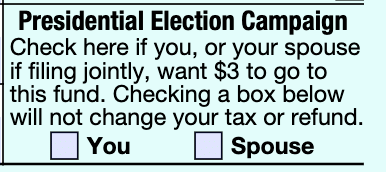
If you’re one of the millions of taxpayers facing the October 15 deadline to file your 2025 federal income tax return with an extension (like me), you may have noticed a small box on Form 1040 asking whether you’d like to contribute to the Presidential Election Campaign Fund.
You might have checked it. You might have skipped it. Or you might not have noticed it at all (it’s pretty small).
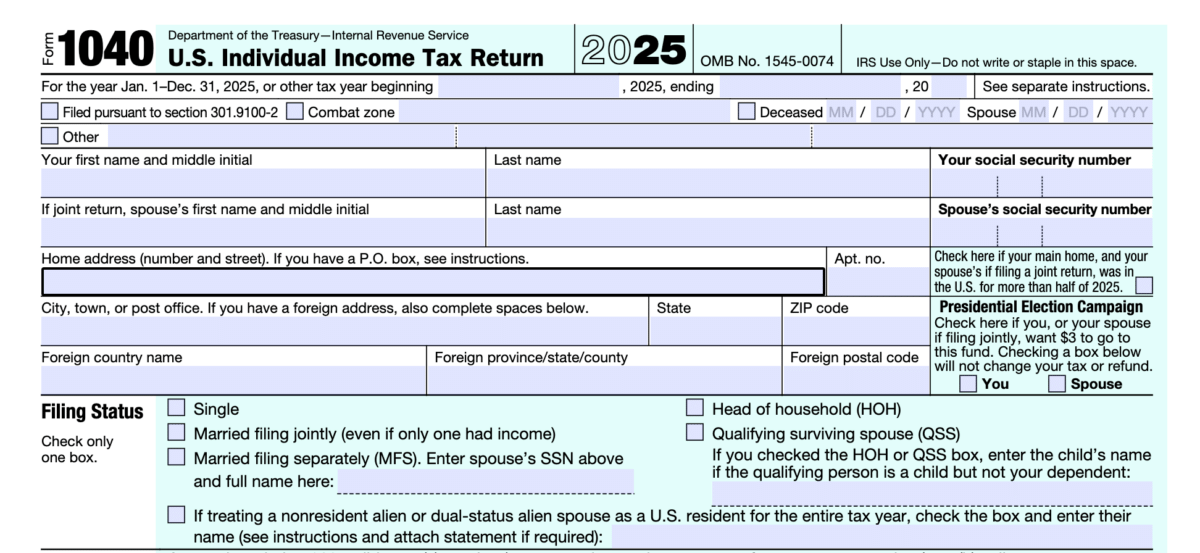
The checkbox has been part of the federal income tax filing process for more than 50 years, allowing taxpayers to direct a small portion of their federal tax dollars toward financing presidential elections. It sounds simple enough, but the history of the Presidential Election Campaign Fund—and what happens to that money—is more complicated.
Despite dramatic changes in how presidential candidates raise and spend money, the checkbox isn’t going anywhere just yet. It appears on the draft Form 1040 for 2026, with no proposed changes (it’s even in the same spot).
So why does the federal government still ask taxpayers whether they want to help finance presidential campaigns? And does anyone actually use the money?
What Happens When You Check The Box?
First, the good news: Checking the box won’t cost you anything extra.
If you check the box marked “You” on Form 1040, $3 of your federal income tax goes to the Presidential Election Campaign Fund. If you’re married and filing jointly, your spouse can make the same election, bringing the total to $6.
The money doesn’t come out of your refund, and it doesn’t increase your tax liability. Instead, the federal government directs that portion of tax revenue to the fund.
It’s also not a charitable contribution (so you can’t deduct it) or an additional tax. It’s simply an opportunity to designate how a portion of your tax dollars will be used—something you don’t often have the luxury of doing at the federal level.
You also don’t get to choose which candidate receives the money. The fund is administered under
federal campaign finance rules, not according to your political preferences (but keep reading).
How Did The Presidential Election Campaign Fund Get Started?
The idea dates back to 1966, when Congress first authorized a presidential campaign financing mechanism through the federal income tax system. Congress suspended that initial effort the following year, but revived it in 1971. Beginning with 1972 tax returns, taxpayers could designate $1 of their federal income taxes to the Presidential Election Campaign Fund.
Initially, taxpayers had to file a separate form—Form 4875—to make the election, and they could even choose whether their money went to a particular political party or a general campaign fund.
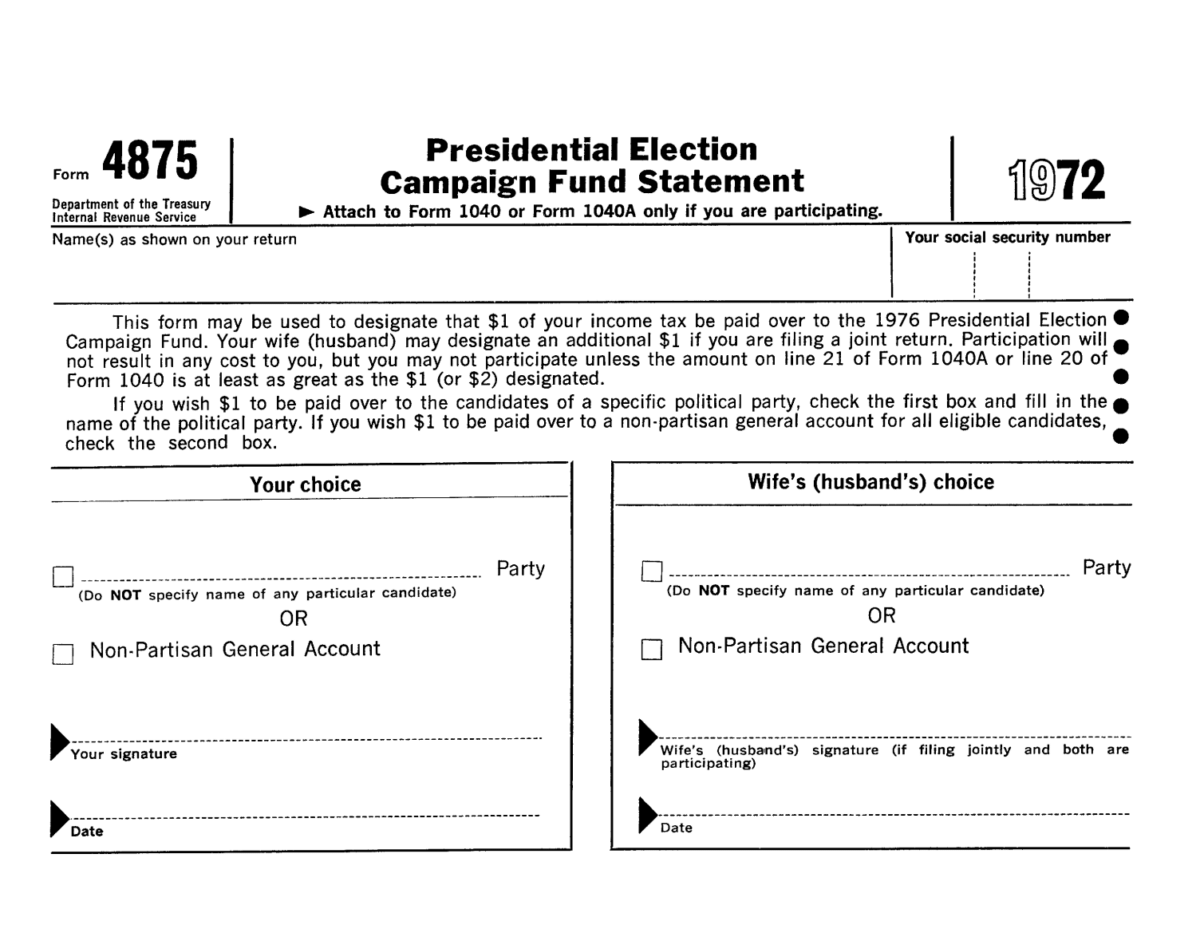
That option disappeared when Congress changed the rules, and the familiar checkbox appeared directly on Form 1040 beginning with 1973 tax returns. The change made a difference. According to the IRS, only 3.1% of returns processed in the first year included a designation. After the election moved directly onto Form 1040, that figure jumped to 13.6% of returns processed during the first half of 1974.
The timing was significant. Congress was already concerned about wealthy donors’ influence on presidential elections, and the Watergate scandal would soon add momentum for campaign finance reform. Public financing offered a possible solution. Instead of relying entirely on private donors, qualifying candidates could receive federal funds to help pay for their campaigns. In exchange, they would agree to restrictions on fundraising and spending.
Beginning with the 1993 tax returns, the amount increased to $3. It’s never been indexed for inflation. If the original $1 had been adjusted for inflation, it would be about $8.15 (according to calculations from the Bureau of Labor Statistics).
Where Did The Money Go?
Historically, the Fund supported three parts of the presidential election process. During the primaries, qualifying candidates could receive federal matching funds based on eligible contributions from individual donors. For the general election, eligible nominees could receive a larger public grant to finance their campaigns. For years, the fund also helped pay for national conventions, where political parties formally nominated their presidential candidates.
That changed in 2014, thanks to an unusual bipartisan effort—and the advocacy of a 10-year-old girl. Gabriella “Gabby” Miller of Virginia became an outspoken advocate for childhood cancer research after being diagnosed with an inoperable brain tumor. She died in October 2013, but her efforts helped inspire legislation that would end public financing for presidential nominating conventions and authorize funding for pediatric medical research.
The Gabriella Miller Kids First Research Act passed the House 295–103 and cleared the Senate by unanimous consent. President Barack Obama signed it into law on April 3, 2014. The legislation eliminated public financing for presidential nominating conventions and established a fund to support a pediatric research initiative at the National Institutes of Health (NIH).
Not everyone supported the approach. Some Democrats argued that the relatively modest funding increase distracted from much larger NIH budget cuts. Although the law authorized the funding, Congress still had to appropriate the money (the first appropriation followed in fiscal year 2015). Beginning with the 2016 presidential election, the major political parties no longer received public money from the Fund to finance their nominating conventions.
Where Does The Money Go Now?
More recently, Congress has redirected hundreds of millions of dollars from the Presidential Election Campaign Fund to other federal programs. In 2024, Congress authorized a $400 million transfer from the fund through two appropriations laws. Under Public Law 118-42, $25 million went to the Department of Justice, and $55 million went to the U.S. Election Assistance Commission. Under Public Law 118-47, another $320 million went to the U.S. Secret Service to support its protective operations.
The transfers are documented in the Federal Election Commission’s (FEC) monthly reports and underscore how much the program has changed since its creation. What began as a way for taxpayers to help finance presidential campaigns has also become a funding source for other congressionally authorized purposes.
That doesn’t mean taxpayers who check the box are choosing to fund those agencies directly. But it does mean that money accumulated in the Fund hasn’t necessarily been spent on presidential candidates.
Who Qualifies For Public Campaign Money?
Thinking of throwing your hat into the ring in exchange for election funding? Not every presidential candidate can simply request a check from the federal government.
To qualify for primary matching funds, candidates must show broad public support by raising more than $5,000 in at least 20 states. Only the first $250 from each individual contributor counts toward that threshold. These requirements date to the 1974 campaign finance reforms and have remained essentially unchanged for more than 50 years, despite inflation and the enormous rise in the cost of presidential campaigns.
Candidates must also agree to campaign spending limits, restrictions on using public funds, and financial reporting and audit requirements (which might explain why they largely turn down the money).
Do Presidential Candidates Still Use Public Money?
Not many. In fact, only two candidates qualified for presidential primary matching funds in 2024: former Vice President Mike Pence, who sought the Republican nomination, and Green Party candidate Jill Stein. The FEC certified approximately $1.56 million in matching funds for Pence and nearly $380,000 for Stein.
Interestingly, Pence suspended his campaign in October 2023, months before the FEC declared him eligible for public financing. But under federal election rules, qualifying candidates can keep receiving matching funds to satisfy outstanding campaign obligations even after they stop actively campaigning.
Neither Donald Trump nor Kamala Harris accepted public financing for the 2024 general election.
For context, the FEC reports that presidential candidates spent $1.8 billion during the 2023–2024 election cycle, covering January 1, 2023, through December 31, 2024. That figure includes only presidential candidate committees. It excludes spending by super PACs, political parties, and other outside groups that support or oppose presidential candidates.
Congress created public financing to reduce presidential candidates’ dependence on private fundraising. But clearly, today, candidates competing for the White House generally raise their money elsewhere.
Are Taxpayers Still Checking The Box?
Some taxpayers still check the box, but participation has fallen since the program’s early years. According to historical IRS data, participation peaked in 1980, when 28.7% of returns reflected the election. By the early 2010s, it had fallen to about 6%. In 2024, it was 3.14% (yikes).
Still, the money hasn’t stopped coming in. According to the Federal Election Commission, taxpayers designated about $21.2 million to the fund in calendar year 2024 and $19.7 million in 2025.
And today, the checkbox remains on Form 1040, and qualifying presidential candidates can still receive public funding. But the system looks very different from the one Congress envisioned more than half a century ago.
So tell me: Are you still checking the box?




Want more Taxgirl?
Get tax news, explainers, deadlines, and more delivered straight to your inbox.
Subscribe →