

What’s Your Tax Rate? It’s Complicated.
“What’s your tax rate?”
It sounds like a simple question, but if you’ve ever tried to answer it, you know it’s a little more complicated than it seems. That’s because not all tax rates are created equal.
Many people think of their tax rate as the highest rate that applies to their income. That’s the rate you might see when looking at a federal income tax table like this one (the 2026 tax table for single taxpayers):
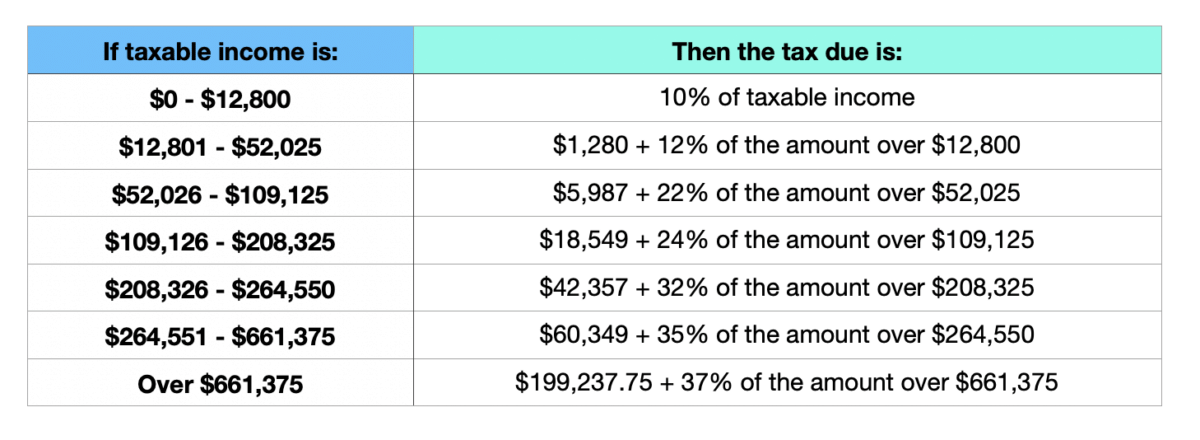
Let’s assume you’re single and have taxable income of $100,000 in 2026. You might look at the table and assume your tax rate is 22%. And it is, sort of—but not for all of your income.
Marginal Tax Rates
We have a progressive federal income tax system. That means tax rates generally increase as taxable income increases. But it doesn’t mean all of your income is taxed at the highest rate you reach.
Back to our example. That 22%? That’s your marginal tax rate, or your top rate. It means that the last dollar of your taxable income falls into the 22% bracket. But not every dollar you earned was taxed at 22%.
Here’s how it actually works:
- The first $12,400 of taxable income is taxed at 10% (the same as every other single taxpayer).
- Income over $12,400 and up to $50,400 is taxed at 12% (again, the same as every other single taxpayer).
- Income over $50,400 and up to $105,700 is taxed at 22% (and yet again, the same as every other single taxpayer).
In other words, everyone filing as single is subject to the same ordinary income tax rates on the same portions of taxable income. Moving into a higher bracket doesn’t mean that all of your income suddenly gets taxed at that higher rate.
If you do the math, the federal income tax on $100,000 of taxable income is $16,712, assuming all of that income is subject to ordinary income tax rates and no credits or other adjustments apply. That’s considerably less than the $22,000 you might expect if you simply multiplied $100,000 by 22%.
Effective Tax Rates
Your tax rate is actually something we call the effective tax rate. An effective tax rate can have different meanings depending on the context, but it’s generally an average tax rate. Rather than looking at the rate that applies to your last dollar of income, it considers the tax you pay relative to a broader measure of your income.
At its simplest, you can calculate an effective federal income tax rate by dividing your federal income tax by your taxable income.
In our example, that’s $16,712 divided by $100,000, for an effective tax rate of 16.71%. That’s a much better reflection of the tax imposed on your taxable income than the 22% marginal rate. Of course, you could argue that 16.71% still isn’t really your tax rate. That’s because taxable income isn’t the same thing as gross income. Taxable income is calculated after certain deductions and adjustments, meaning the amount you’re taxed on can be considerably less than the amount you actually earned.
It’s possible for one taxpayer to have gross income of $150,000 and another to have gross income of $105,000, yet both end up with $100,000 in taxable income. Assuming the same filing status and tax treatment, they’d have the same effective tax rate when measured against taxable income, even though their tax bills would represent very different percentages of their gross income.
Why Your Effective Tax Rate Matters
It’s also part of the reason you sometimes hear that Warren Buffett pays a lower tax rate than his secretary. Wealthy taxpayers may receive substantial amounts of income from investments rather than wages, and different kinds of income can receive very different tax treatment. Long-term capital gains, for example, are generally taxed at preferential rates, while unrealized appreciation in assets generally isn’t subject to federal income tax until a taxable event occurs.
Deductions, exclusions, and other tax preferences can also reduce taxable income. As a result, the percentage of a wealthy taxpayer’s total economic income that goes toward federal income taxes may be considerably lower than you might expect from looking at the top marginal tax rate.
And that’s before we consider other items that can complicate the calculation, including capital gains and losses, net operating losses, and deductions that don’t necessarily reflect current economic outlays, such as depreciation.
Don’t forget that we’re also talking primarily about federal income tax. We haven’t factored in Social Security and Medicare taxes, which affect wage earners differently depending on their income levels, or additional taxes like the Alternative Minimum Tax (AMT), the Net Investment Income Tax (NIIT), and the Additional Medicare Tax on higher earners.
All of these can affect how much tax you actually pay.
So, What’s Your Tax Rate?
The answer depends on what you’re measuring.
Your marginal tax rate tells you the rate that applies to your next dollar of ordinary taxable income. Your effective tax rate tells you how much tax you pay, on average, relative to a particular measure of income. Neither number is necessarily wrong. They just answer different questions.
So the next time someone asks, “What’s your tax rate?” you might want to ask them which one they mean.




Want more Taxgirl?
Get tax news, explainers, deadlines, and more delivered straight to your inbox.
Subscribe →