

The Saver’s Match Arrives In 2027: Who Qualifies For Up To $1,000?
Are you looking for a new opportunity to save for retirement? Starting in 2027, eligible taxpayers may get a little help from the federal government: a matching contribution of up to $1,000 per person, deposited into a retirement account.
The new program, called the Saver’s Match, is designed to help low- and moderate-income Americans build retirement savings. For most taxpayers, it replaces the Saver’s Credit, but there’s an important difference. Instead of simply reducing a taxpayer’s income tax bill, the government will contribute money directly to your qualifying retirement account. That could make the benefit available to more taxpayers, particularly those whose incomes are low enough that they owe little or no federal income tax.
The program officially begins in 2027, with the first matching contributions expected in 2028, after you file your 2027 federal income tax return.
Here’s how the program developed, what’s changing, and who qualifies.
A Little History: The Original Saver’s Credit
Congress created the Retirement Savings Contributions Credit, better known as the Saver’s Credit, under the Economic Growth and Tax Relief Reconciliation Act of 2001. The credit took effect in 2002 and was originally scheduled to expire after 2006. Instead, Congress made it permanent under the Pension Protection Act of 2006.
The goal of the original credit was to encourage workers who might otherwise struggle to save for retirement to contribute to an IRA or a workplace retirement plan. Under the Saver’s Credit, eligible taxpayers could claim a nonrefundable federal income tax credit equal to 10%, 20%, or 50% of qualifying retirement contributions, depending on their income and filing status.
The maximum credit was $1,000 per eligible person, or $2,000 for a married couple filing jointly when both spouses qualified. But there was a catch. Because the credit was nonrefundable, it could reduce a taxpayer’s federal income tax liability to zero, but it couldn’t generate a refund beyond that liability. As a result, taxpayers with little or no federal income tax liability often couldn’t take full advantage of the credit, even if they were contributing to retirement accounts.
In other words, the program was designed to encourage lower-income workers to save, but some couldn’t fully benefit.
From Saver’s Credit To Saver’s Match
Enter the Saver’s Match. Congress created the Saver’s Match as part of the SECURE 2.0 Act of 2022, which was enacted on December 29, 2022. The Saver’s Match, effective for tax years beginning after December 31, 2026, provides a government contribution to an eligible taxpayer’s designated retirement account, not a nonrefundable income tax credit.
You can qualify for the match even if you owe little or no federal income tax, as long as you meet the other requirements.
In August 2026, the Treasury Department and the IRS announced their intention to issue regulations implementing the Saver’s Match, including procedures for determining eligibility, claiming the benefit, and directing government contributions to retirement accounts. And the IRS has also begun reaching out to potential beneficiaries. A new notice, CP321J, alerts taxpayers who claimed the Saver’s Credit or whose income suggests they may qualify for the new program. Receiving the notice doesn’t guarantee eligibility, but it’s intended to encourage you to consider retirement contributions before the program begins.
How Does The Saver’s Match Work?
Beginning in 2027, the federal government will match up to 50% of the first $2,000 in qualifying retirement contributions an eligible taxpayer makes, for a maximum annual match of $1,000 per person.
For example, assuming you qualify for the full 50% match:
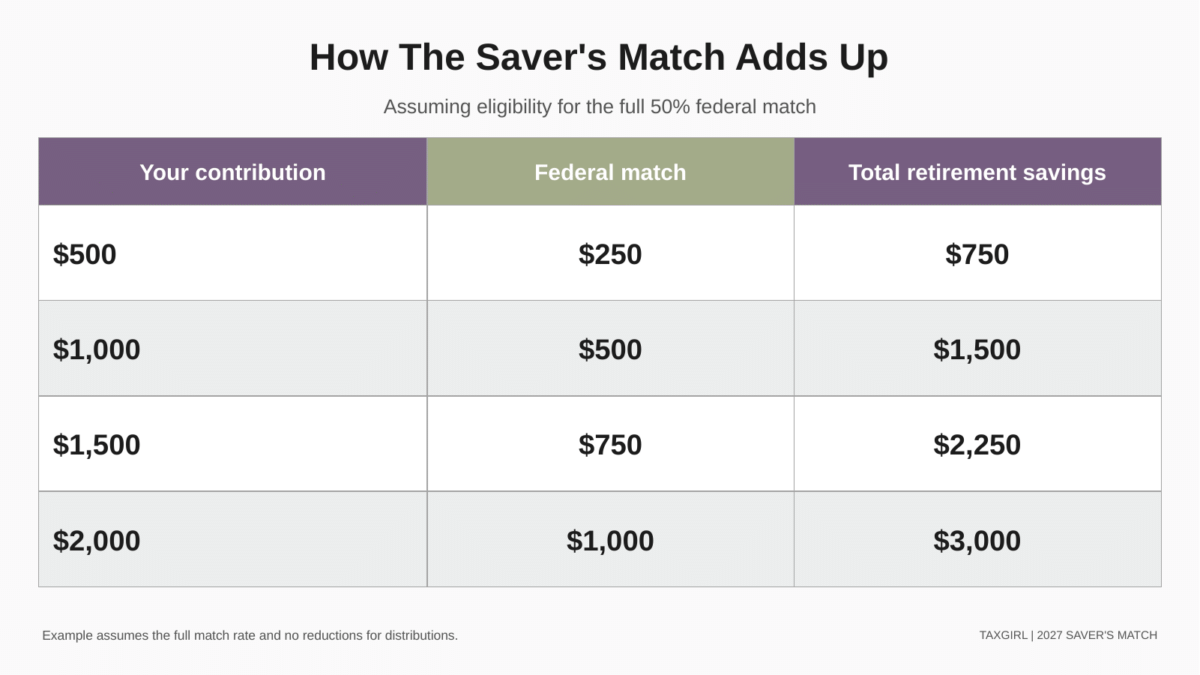
You don’t need to contribute the full $2,000 to receive a benefit, and there’s no minimum contribution requirement.
The government match is also separate from any employer match.
And, if you’re married filing jointly, you could receive up to $2,000 in combined federal matching contributions if both you and your spouse contribute enough and independently meet the eligibility requirements.
Who Qualifies For The Saver’s Match?
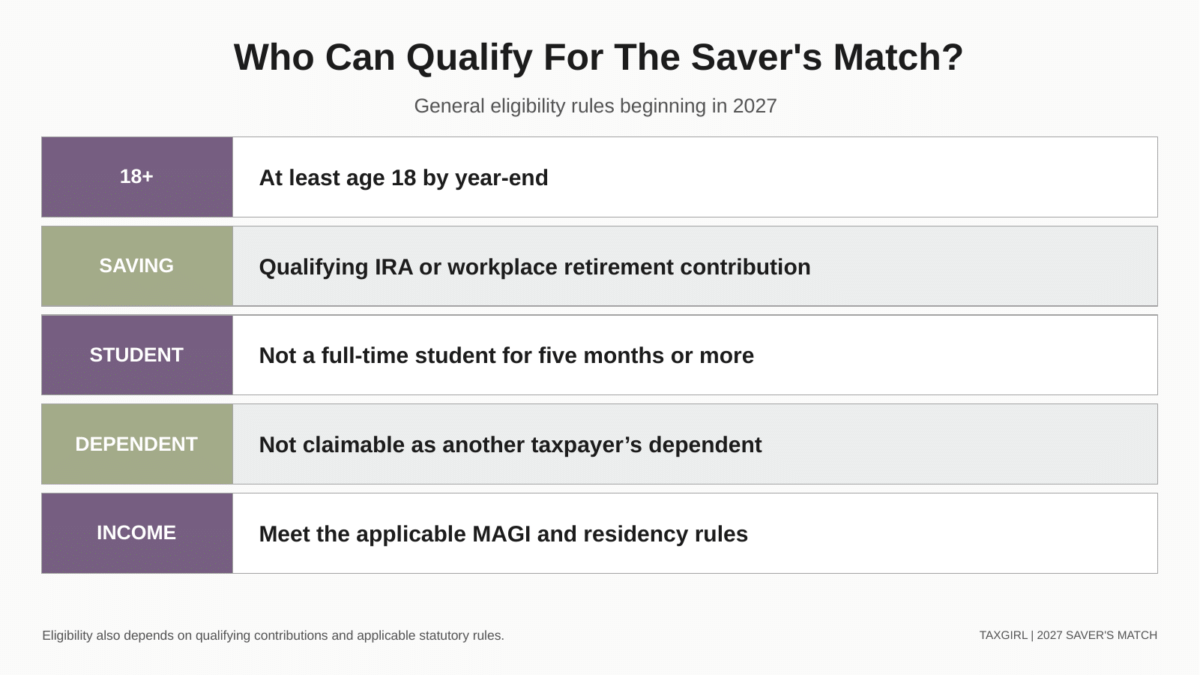
The Saver’s Match is intended for low- and moderate-income taxpayers, and eligibility depends on several factors. Generally, you must:
- Be at least age 18 by the end of the tax year.
- Make qualifying contributions to an eligible retirement account.
- Not be a full-time student for at least five months of the year, under the applicable tax rules.
- Not be claimed as a dependent on someone else’s tax return.
- Meet the applicable residency and income requirements.
You do not need a federal income tax liability to receive the match.
2027 Saver’s Match Income Limits
The federal match amount depends on filing status and modified adjusted gross income (MAGI).
For 2027, the income limits are:
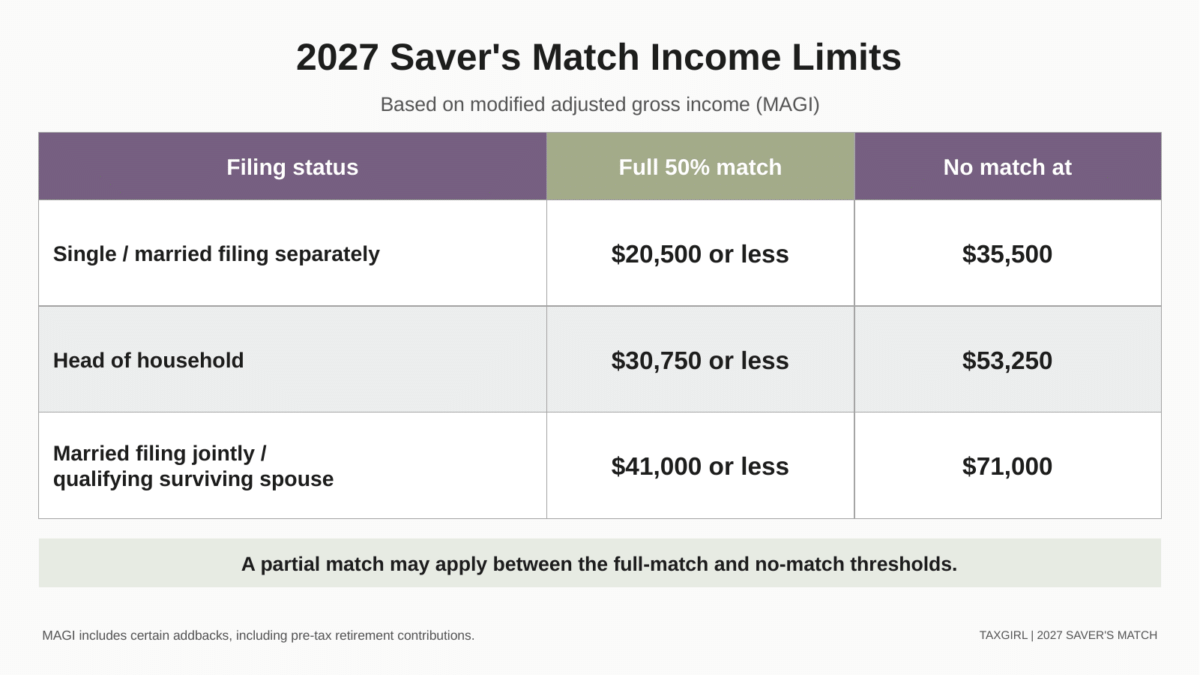
If your income falls within the phaseout ranges, you may qualify for a lower match percentage. The match percentage gradually declines as income increases.
These income thresholds are scheduled to be adjusted for inflation in years after 2027.
An Important Detail About Income
For the Saver’s Match, MAGI isn’t necessarily the same as the adjusted gross income (AGI) on your tax return. The calculation generally adds back certain amounts, including pre-tax retirement plan contributions, deductible traditional IRA contributions, and specified excluded foreign income.
That means contributing more to a traditional 401(k) or a deductible IRA won’t necessarily lower your MAGI enough to qualify for a larger Saver’s Match.
Which Retirement Accounts Qualify?
Qualifying contributions generally include those made to traditional and Roth IRAs, as well as employee contributions to eligible workplace retirement arrangements, including 401(k), 403(b), governmental 457(b), and certain SIMPLE and SEP plans. That doesn’t mean every retirement account will automatically accept the government’s matching contribution.
You must designate a qualifying retirement plan or IRA to receive the funds, and the receiving arrangement must be willing and able to accept Saver’s Match payments.
There’s an important distinction: A contribution to a Roth IRA can help you qualify for the match, but the government’s contribution generally must be deposited into an eligible non-Roth retirement account. You may need to designate a different account to receive it.
How And When Will Taxpayers Receive The Match?
The Saver’s Match won’t appear automatically in your retirement accounts as you contribute in 2027. Instead, you’ll claim the Saver’s Match on Form 8880-A when you file your 2027 federal income tax return in 2028.
You’ll designate a retirement account to receive the government’s payment. Unlike a traditional income tax refund, the match will typically go into retirement savings rather than a checking account.
There’s a limited exception: If the government match you’re entitled to is less than $100, you may elect to receive it as a refundable tax credit instead of having it deposited into a retirement account.
What Could Reduce Your Saver’s Match?
Making a contribution doesn’t necessarily guarantee the full matching amount.
For one thing, the match depends on income. Even if you meet the basic eligibility requirements, you may qualify for only a partial match.
Certain retirement account withdrawals can reduce the contributions used to calculate the match. For example, let’s say you contribute $2,000 to a 401(k) in 2027 but also take a $500 IRA distribution during the applicable period. Assuming the distribution must be taken into account, only $1,500 of the contribution may count toward calculating the match.
At a 50% matching rate, that would reduce the federal contribution from $1,000 to $750.
The distribution rules include a look back period covering the two preceding tax years, as well as specified periods surrounding the contribution year. Certain rollovers and other transactions are excluded. So, if you’ve recently taken retirement distributions, review these rules carefully before assuming you qualify for the maximum match.
What Happens To The Old Saver’s Credit?
The Saver’s Credit isn’t disappearing entirely. Beginning in 2027, the Saver’s Match replaces the Saver’s Credit for eligible contributions to retirement plans and IRAs.
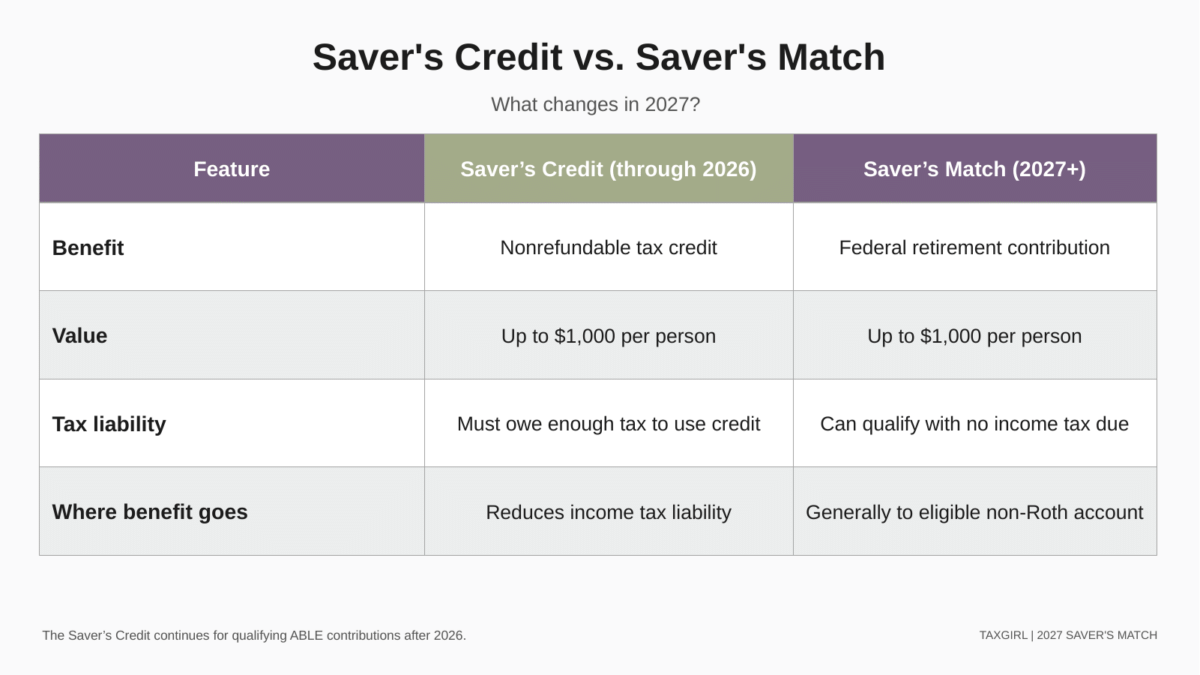
However, the Saver’s Credit remains available for qualifying contributions to Achieving a Better Life Experience (ABLE) accounts. ABLE accounts are tax-advantaged savings accounts for eligible individuals with disabilities.
For 2027, the income limits for the Saver’s Credit are $41,500 for single filers and married individuals filing separately, $62,250 for heads of household, and $83,000 for married couples filing jointly. Importantly, the 2027 Saver’s Credit income thresholds differ from those for the new Saver’s Match.
How To Take Advantage Of The Saver’s Match In 2027
Although the first government payments won’t arrive until 2028, taxpayers can begin preparing now.
Here are some practical steps:
- Check your eligibility. Review the 2027 income thresholds and eligibility requirements to see whether you qualify for the full or partial match (or no match at all).
- Consider opening a retirement account. If you don’t have access to a workplace plan, a traditional or Roth IRA may let you make eligible contributions.
- Start with an amount you can afford. You don’t need to contribute $2,000 to qualify. Even smaller amounts may generate a federal match.
- Review your existing retirement contributions. If you’re already saving through an employer-sponsored plan, those contributions may help you qualify without needing a separate contribution.
- Keep records. It’s the most predictable Taxgirl advice (!), but it’s important. Save documentation for retirement contributions and relevant distributions because you’ll need information on your qualifying contributions when claiming the match.
- Check where the government contribution can go. Not all plans will accept direct Saver’s Match payments. Make sure you have an eligible destination before filing your 2027 return.
And don’t forget that claiming the match will require you to file a federal income tax return, even if you otherwise have little or no income tax liability.
The Bottom Line
For more than two decades, the Saver’s Credit has offered a tax incentive to encourage retirement savings among low- and moderate-income workers. Beginning in 2027, the Saver’s Match takes a different approach.
The original credit was a tax incentive. The new match is a direct retirement-savings incentive.
The rules are more complicated than the headline numbers suggest, especially around income, qualifying contributions, and which accounts can receive payments. But the underlying idea is simple: Help taxpayers who are saving for retirement build a little more for the future.