

2027 Retirement Contribution Limits: What’s Changing And How To Save More
If you’re saving for retirement, you may be able to put away more in 2027 thanks to inflation adjustments announced by the IRS. The amount you can contribute to most 401(k) plans will rise to $25,500 in 2027, up from $24,500 in 2026. If you’re age 50 and older, you can save even more thanks to higher catch-up contribution limits. And if you’re approaching retirement, you may be able to set aside more than $37,000 in a single year.
Not every limit is increasing. IRA contribution limits will remain the same, though higher income thresholds could allow more taxpayers to qualify for tax benefits.
Here’s a look at the new numbers, what they mean, and how to make the most of them.
401(k) and Other Workplace Retirement Plans
For 2027, employees who participate in 401(k), 403(b), most governmental 457 plans, and the federal government’s Thrift Savings Plan (TSP) can contribute up to $25,500. That’s a $1,000 increase over 2026.
Workers age 50 and older can also make additional catch-up contributions. For 2027, the general catch-up limit increases to $8,500, bringing the combined limit to $34,000. Workers ages 60 through 63 have an even greater opportunity to save under provisions introduced by the SECURE 2.0 Act. Their higher catch-up contribution limit increases to $11,750, allowing total contributions of up to $37,250.
The age-based limits apply to eligible participants in the covered workplace plans. An individual’s age at the end of 2027 determines the applicable catch-up category.
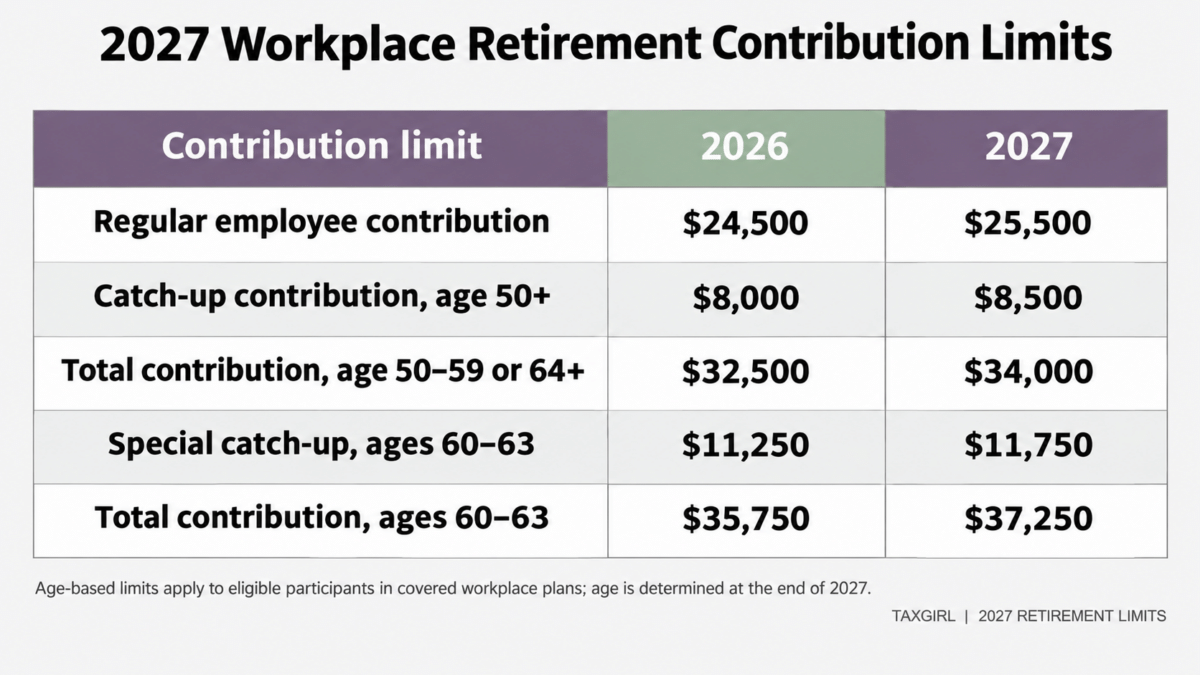
The higher limits create an opportunity to contribute more to retirement savings while potentially reducing your current taxable income. For example, if you contributed the maximum $24,500 to a traditional 401(k) in 2026, you could contribute an additional $1,000 in 2027. Assuming pre-tax contributions, that extra amount generally reduces taxable income by $1,000.
The actual tax savings depend on your marginal tax rate and circumstances. And remember, the limits are ceilings, not recommendations. You don’t have to contribute the maximum to benefit. Even a small increase in contributions can make a difference over time.
How to benefit: Review your payroll elections before the start of 2027. To contribute the new maximum and receive 26 biweekly paychecks, you’d need to defer about $981 per paycheck, before any catch-up contributions.
Also, make sure you’re contributing enough to receive your employer’s full matching contribution, if one is offered—that’s free money! If you’re not sure whether your company offers a match, or how much it might be, ask your benefits person at work. Notably, an employer match is separate from the employee deferral limit.
IRA Contribution Limits Remain Unchanged
Unlike workplace retirement plans, the annual IRA contribution limit will not increase for 2027. You can contribute up to $7,500 to traditional and Roth IRAs, the same amount as in 2026. The catch-up contribution limit for taxpayers age 50 and older also remains unchanged at $1,100.
These are combined contribution limits for traditional and Roth IRAs, not separate limits for each account.
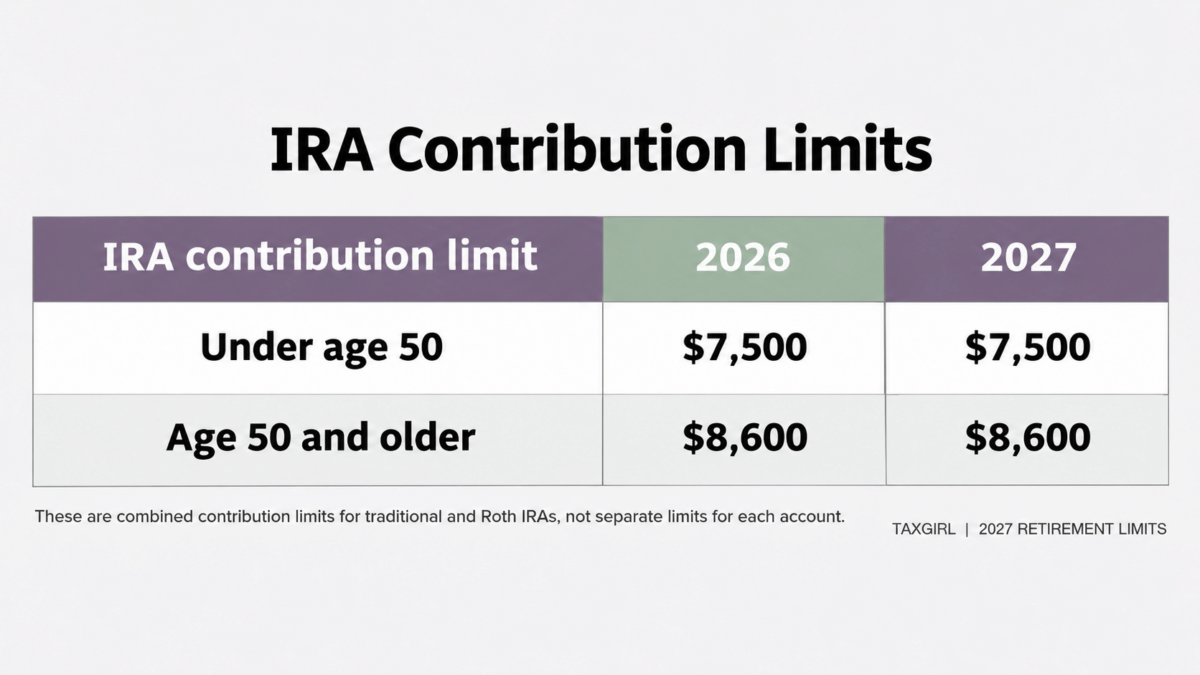
Even though the contribution limit hasn’t changed, IRAs remain an important retirement savings option—particularly if you don’t have access to an employer-sponsored retirement plan or want to add to your workplace savings. Traditional IRAs may offer a current-year tax deduction, depending on income and whether you or your spouse participate in a workplace retirement plan.
Roth IRAs work differently. Contributions aren’t tax-deductible, but qualified withdrawals are tax-free.
How to benefit: If you plan to contribute the maximum to an IRA in 2027, setting aside $625 each month would get you to $7,500 by year-end. Taxpayers age 50 and older would need to save approximately $717 monthly to reach their $8,600 limit.
Remember that eligibility rules apply.
Traditional IRA Deduction Income Limits Increase
Making a traditional IRA contribution and deducting that contribution are two different things. You may be able to contribute to a traditional IRA even if you cannot deduct the contribution on your federal income tax return. Whether contributions are deductible depends partly on income, filing status, and whether you or your spouse is covered by a workplace retirement plan.
For 2027, the income phaseout ranges for traditional IRA deductions are increasing.
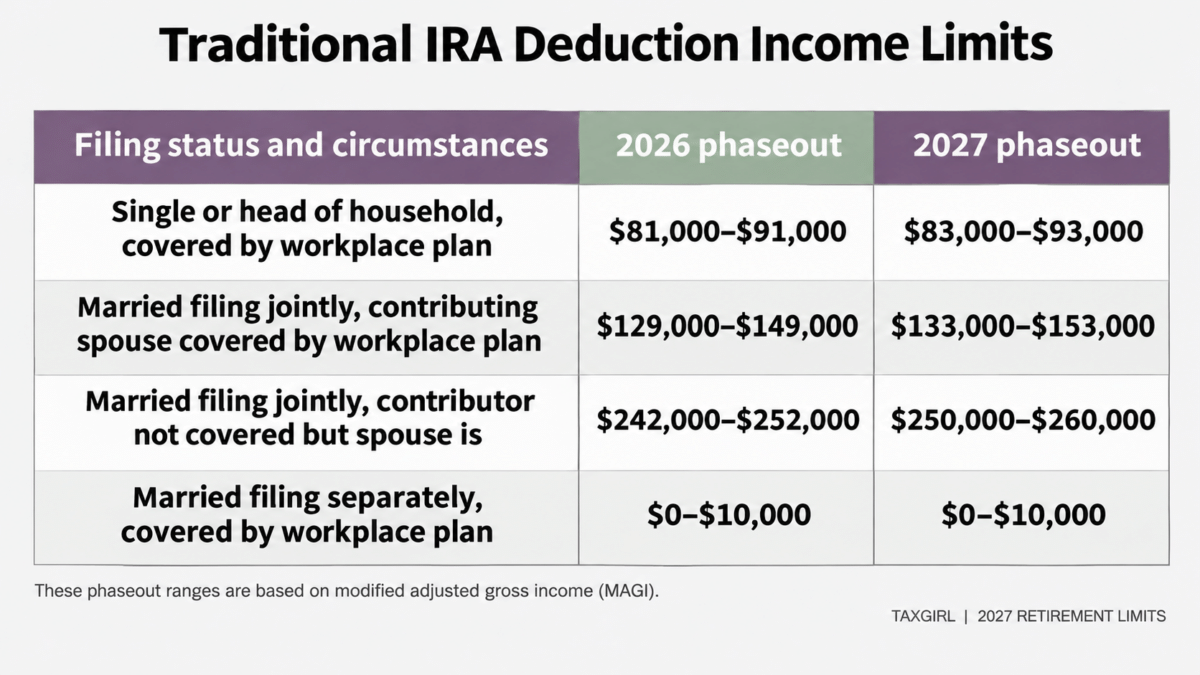
These ranges are based on modified adjusted gross income (MAGI). Special rules may apply in certain circumstances.
A higher phaseout range means that even if you couldn’t deduct your full traditional IRA contributions in 2026, you may qualify for a deduction in 2027. For example, if you’re a single taxpayer covered by a workplace retirement plan with MAGI of $82,000, you were within the deduction phaseout range for 2026. In 2027, that same income would fall below the new $83,000 phaseout starting point, potentially allowing a full deduction. (If neither you nor your spouse, if married, is covered by a workplace retirement plan, these income-based deduction phaseouts don’t apply.)
How to benefit: Don’t assume that last year’s IRA deduction rules will produce the same result in 2027. Review your eligibility, especially if your income is close to one of the phaseout ranges.
Roth IRA Income Limits Also Increase
Roth IRAs are popular because qualified withdrawals are tax-free. However, income limits determine whether you can contribute directly to a Roth IRA. Those income limits are increasing for 2027.
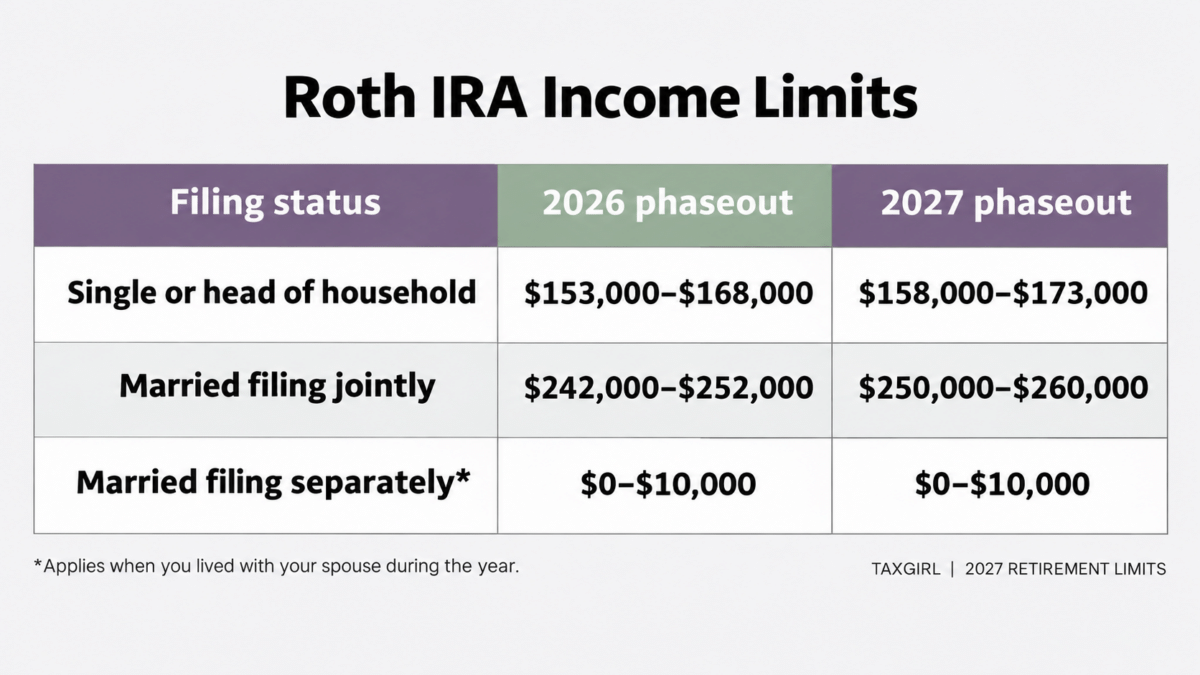
The listed married-filing-separately range applies when you lived with your spouse during the year.
Higher phaseout limits mean that if you earned too much to contribute directly to a Roth IRA in 2026, you may be eligible in 2027. For example, if you’re a single taxpayer with MAGI of $155,000, you fell within the Roth IRA phaseout range in 2026. That same income would be below the phaseout threshold in 2027, potentially allowing a full contribution.
How to benefit: Check your projected 2027 income before ruling out a direct Roth IRA contribution. Keep in mind that the phaseouts are based on MAGI, which may differ from the salary shown on your paycheck.
A Catch-Up Contribution Change For Higher Earners
Under SECURE 2.0, certain higher-earning employees must make their workplace retirement plan catch-up contributions on a Roth basis rather than a pre-tax basis. The rule took effect in 2026. For 2027, the requirement applies when your 2026 wages subject to Social Security tax from the plan’s sponsoring employer exceed $155,000. That threshold is increasing from the $150,000 applicable for 2026.
If the requirement applies, your catch-up contributions won’t reduce your current taxable income. Instead, they’ll be treated as Roth contributions, which may provide tax-free qualified distributions in retirement.
The rule doesn’t require all of your retirement contributions to be Roth contributions. It applies only to catch-up contributions.
How to benefit: If you’re age 50 or older and earned more than $155,000 in Social Security wages from the employer sponsoring your plan in 2026, check with your plan administrator about how your 2027 catch-up contributions will be handled.
SIMPLE Retirement Plan Limits Increase
If you participate in SIMPLE retirement plans, you will also see higher contribution limits. For 2027, the general employee contribution limit increases to $17,500, up from $17,000 in 2026. Certain qualifying SIMPLE plans have a higher contribution limit of $19,100, up from $18,100. The applicable contribution and catch-up limits depend on the type of SIMPLE plan and its governing rules.
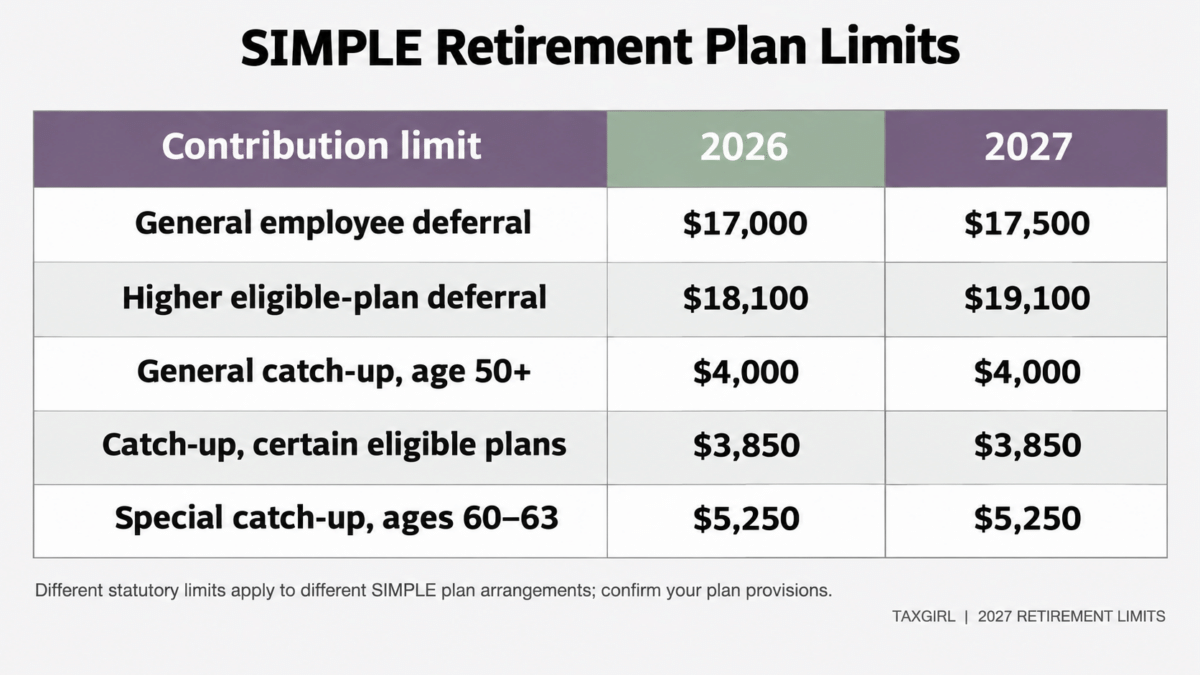
How to benefit: Confirm which limit applies to your plan. If you’re a small-business owner, review your plan provisions and communicate any changes to your employees before the new year.
A New Retirement Savings Benefit Arrives In 2027
The Saver’s Match, created under SECURE 2.0, replaces the existing Saver’s Credit for qualifying retirement plan and IRA contributions beginning in 2027. Under the new program, eligible low- and moderate-income taxpayers who contribute to a qualifying retirement account may receive a federal matching contribution of up to 50% of the first $2,000 saved.
That means a potential government contribution of up to $1,000 per eligible person.
Unlike the traditional Saver’s Credit, which reduces income tax liability, the Saver’s Match normally goes directly into a designated retirement account. For 2027, taxpayers with MAGI of $35,500 or more (single), $53,250 or more (head of household), or $71,000 or more (married filing jointly) are ineligible for the match. Lower income thresholds apply for the full 50% match, with partial matching available within the phaseout ranges.
The MAGI calculation for the Saver’s Match generally adds back deductible IRA contributions and pre-tax retirement plan contributions, so those contributions won’t necessarily help you qualify by lowering your income. You’ll claim the match on Form 8880-A when filing your 2027 federal income tax return in 2028.
The existing Saver’s Credit will remain available for qualifying contributions to ABLE accounts. The 2027 limits for that credit increase to $41,500 for single filers, $62,250 for heads of household, and $83,000 for married couples filing jointly.
How to benefit: If you qualify, even modest retirement contributions could add more money to your retirement savings. Be sure to check the income and eligibility rules, which differ from those for the old Saver’s Credit.
Other Retirement Limits Worth Knowing
The IRS also announced adjustments to several other retirement-related limits for 2027.
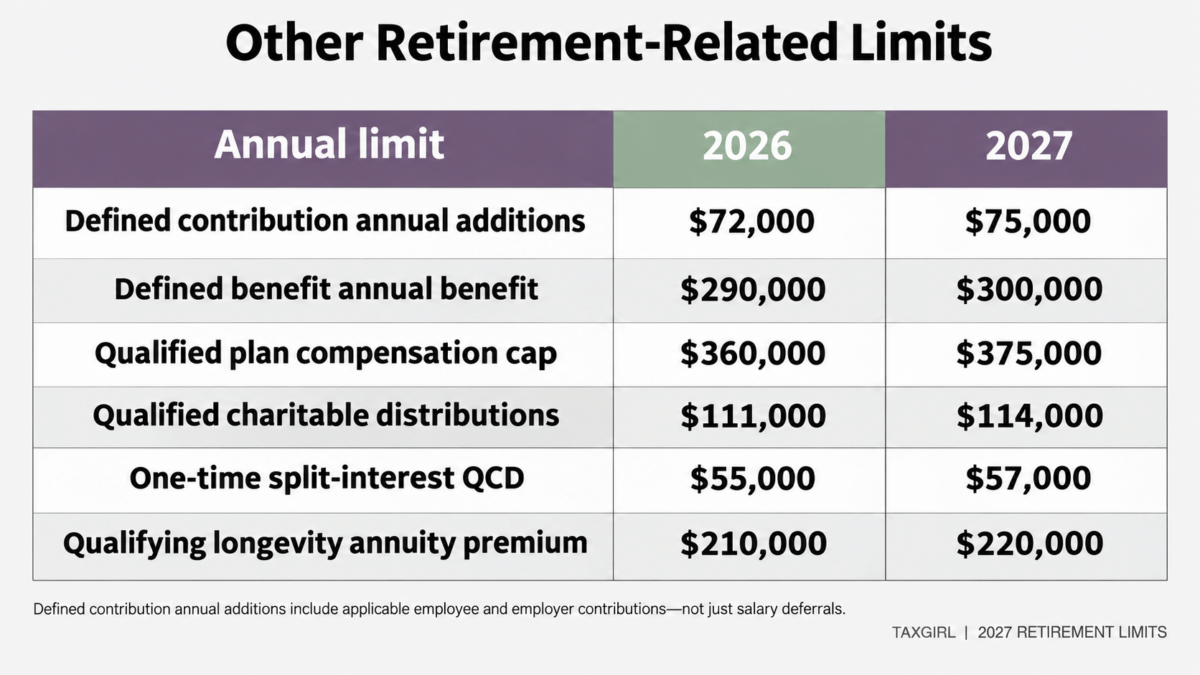
The $75,000 defined contribution plan limit applies to total annual additions, including employee and employer contributions, subject to applicable rules. It is not the amount an employee can simply elect to defer from a paycheck.
The qualified charitable distribution (QCD) increase may be particularly useful for taxpayers age 70½ or older who wish to make qualifying charitable donations directly from their IRAs. These distributions typically aren’t included in income when statutory requirements are met, and they may count toward required minimum distributions. Taxpayers also cannot claim a charitable deduction for the same excluded amount.
How To Make The Most Of The 2027 Retirement Limits
The new limits don’t take effect until January 1, 2027, but there’s no reason to wait until then to start planning.
Here are a few steps to consider:
- Review your retirement contributions. See how much you’re currently saving and whether you can increase it in 2027.
- Check your employer match. If your employer offers matching contributions, understand how much you need to contribute to receive the full benefit.
- Take advantage of catch-up contributions. If you’re at least age 50, check whether you’re eligible to contribute more, particularly if you’ll be between ages 60 and 63 in 2027.
- Revisit IRA eligibility. Higher-income phaseouts could change whether you’re eligible for a traditional IRA deduction or a direct Roth IRA contribution.
- Consider your tax situation. Traditional pre-tax contributions and Roth contributions provide different tax benefits. The best choice depends on your circumstances. If you’re not sure what works best for you, talk with your tax pro.
- Make a plan before January. Workplace contribution elections typically run through payroll. Updating those elections early can help spread contributions throughout the year.
The IRS announced the changes on November 12, 2026, in Notice 2026-66.