
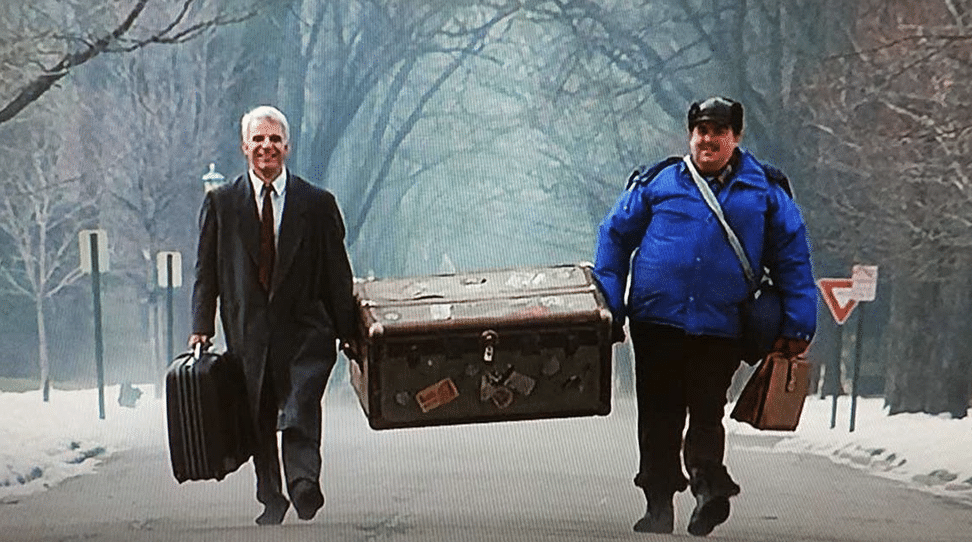
Taxgirl Goes To The Movies: Planes, Trains and Automobiles
In honor of Thanksgiving—and the millions of Americans traveling home for the holiday—I’m bringing back Taxgirl Goes To The Movies.
This time, the featured movie is the 1987 comedy Planes, Trains and Automobiles, starring Steve Martin and John Candy. The movie was written and directed by John Hughes, who also gave us The Breakfast Club, Sixteen Candles, and Ferris Bueller’s Day Off. As it turns out, Hughes drew on his own experiences traveling between New York and Chicago while working in advertising.
The movie opened on November 25, 1987, the day before Thanksgiving. Nearly four decades later, it remains one of my favorite Thanksgiving movies (and was one of my dad’s favorite movies of all time, as it reminded him of his travels with his DuPont colleagues—do with that last bit what you will).
And while most people watching the movie are probably thinking about their own terrible travel experiences, I’m thinking about the poor soul who has to sort out the expense reports.
As always, this review contains spoilers. If you haven’t seen the movie yet, go watch it. I’ll be here when you get back.
The Background
Neal Page (played by Steve Martin) is an advertising executive who is in New York on business two days before Thanksgiving. He’s anxious to get home to his wife and children in suburban Chicago, but his client can’t decide, and the meeting drags on.
Neal’s trip raises our first tax issue: What constitutes business travel?
Generally, travel expenses associated with a business trip are deductible if they are ordinary and necessary and you are traveling away from your tax home. Your tax home is typically where you regularly work, not necessarily where you live.
Assuming that Neal works in Chicago and is only in New York temporarily for the meeting, his airfare, hotel stay, and other qualifying travel expenses would be legitimate business expenses. The fact that he wants to get home in time for Thanksgiving doesn’t transform his return trip into personal travel.
Of course, whether Neal can actually claim those expenses on his own tax return is another matter. In 1987, employees could generally deduct qualifying unreimbursed business expenses if they itemized, subject to a newly imposed limitation: miscellaneous itemized deductions were deductible only to the extent that they exceeded 2% of adjusted gross income (AGI). That deduction disappeared for most employees beginning in 2018, thanks to the Tax Cuts and Jobs Act (TCJA). The 2025 One Big Beautiful Bill Act (OBBBA) made that change permanent for most employees.
Today, Neal would generally be better off submitting his expenses to his employer for reimbursement under an accountable plan. Properly substantiated reimbursements under such a plan aren’t included in his taxable wages.
The Taxi
Neal leaves his meeting and tries to hail a cab. Unfortunately, just about everybody else in New York City seems to be doing the same thing. After losing a footrace for a taxi to another man (played by the six-degrees-of-separation Kevin Bacon), Neal offers to pay someone to give up his cab. They agree on a price, the man pockets the money, and another man takes off in the taxi.
The money that Neal paid to jump the line (even though it was unsuccessful) raises an interesting tax question. We generally think of deductible transportation expenses as cab fares and tips. But what about paying someone else to give up a cab? I’d argue that, assuming the amount is reasonable under the circumstances, it could qualify as a business transportation expense.
And for the guy pocketing the money? It’s taxable income. You don’t have to operate a business to have reportable income.
The Plane
Neal finally makes it to the airport, where he encounters the man who took his cab. It’s Del Griffith (played by the wonderful John Candy), a traveling shower curtain ring salesman. Neal discovers that not only has his flight been delayed, but he’s also lost his first-class seat. When he finally boards the plane, he finds himself in coach, seated next to Del.
Interestingly, there’s no rule in the federal tax code that requires business travelers to fly coach on domestic flights. First-class airfare can qualify as a business expense. Of course, your employer may have a different opinion.
The flight attendant tells Neal that he can complain to the airline later and possibly get a refund. Would that refund be taxable?
Typically, a refund of a ticket’s purchase price isn’t taxable income. But what if Neal deducted the ticket cost as a business expense? If he receives the refund in the same tax year, he would simply reduce his deduction by the amount of the refund. If he receives the refund in a subsequent tax year, he may have to report it as income to the extent that the original deduction resulted in a tax benefit. This is appropriately called the tax benefit rule.
And if Neal’s employer reimbursed him for the cost of the first-class ticket? He should account for the refund to his employer. Otherwise, the excess reimbursement could be treated as taxable wages.
Of course, Neal would much rather have his first-class seat. He suffers through coach only to find that the weather in Chicago makes landing impossible, so the plane is diverted to Wichita, Kansas.
The First Night
Del, who apparently knows everybody everywhere, secures accommodations at the Braidwood Inn. Neal reluctantly agrees to share a room with Del, only to discover that sharing a room also means sharing a bed.
Additional expenses from an unexpected overnight stay during an otherwise legitimate business trip can generally qualify as business expenses. That includes transportation to and from the hotel, lodging, and meals (though business travel meals, which were 80% deductible in 1987, are generally only 50% deductible today).
What about Neal picking up expenses for Del? Simply paying for somebody else’s expenses while you’re on a business trip doesn’t make those expenses deductible. There has to be an independent business purpose. If sharing the room doesn’t increase Neal’s lodging costs, however, sharing it shouldn’t affect the deductibility of his own expense.
After a particularly uncomfortable night (“Those aren’t pillows!”), the two men discover that someone has stolen their cash. Neal initially suspects Del, but it turns out that both men have been robbed. In 1987, Neal and Del might have been able to claim personal theft losses on their federal income tax returns, subject to certain limitations. The TCJA changed that, and the OBBBA made it permanent. Now, the law generally limits net personal casualty and theft loss deductions to losses attributable to qualifying federally or state-declared disasters.
Being stranded in Wichita with Del may constitute a personal disaster for Neal, but it doesn’t count for federal income tax purposes. However, different rules apply to thefts involving business property or property held for profit.
The Train
With the weather still disrupting air travel, Del calls on a business contact to get the pair to the train station. (Apparently, selling shower curtain rings is an excellent way to build a professional network.)
There, Neal buys tickets for different cars, and it seems they might part ways. But the train breaks down, and the passengers are forced to make their way across a field, luggage in hand. Eventually, Neal and Del continue their journey together by bus, making it as far as St. Louis.
You don’t have to use the same mode of transportation throughout a business trip. Switching from a plane to a train to a bus because of circumstances outside your control generally wouldn’t change the character of your travel expenses.
Of course, you should keep your receipts and document any refunds you receive. You can’t claim a deduction for an expense that ultimately costs you nothing.
The Entrepreneur
With cash in short supply, Del demonstrates just how good a salesman he really is. He begins selling shower curtain rings as earrings, making rather dubious claims about their origins and their celebrity associations. He even convinces young women to buy them by suggesting that the earrings make them look older.
(One wonders what Del could accomplish today with an Etsy or TikTok account.)
The money that Del collects from selling the shower curtain rings constitutes reportable business revenue. It doesn’t matter that he doesn’t have a storefront, a business license, or a credit card machine. And it doesn’t matter that he’s selling the merchandise for the express purpose of getting home for Thanksgiving.
Assuming Del owns the inventory and sells it on his own account, he would generally be entitled to offset his sales revenue by the cost of the merchandise. His net business profits would also generally be subject to self-employment tax. And if the shower curtain rings actually belong to his employer (he identifies early on as the Director of Sales for American Light & Fixture)? Well, that’s a different discussion altogether.
Del shares the proceeds from his sales. Assuming it’s a gift rather than compensation or payment for something, Neal generally wouldn’t have to report that money as income. Del, however, wouldn’t get a business deduction simply for sharing his earnings with Neal.
The Rental Car
Neal decides that the two would be better off traveling separately. He rents a car, only to discover no car is waiting for him in the parking lot. After a rather miserable trek back to the rental car counter, Neal encounters a remarkably cheerful rental car agent (played by Edie McClurg).
What follows is one of the funniest—and most profane—scenes in the movie. Neal has thrown away his rental agreement, and the rental car agent insists that she needs it.
There’s a tax lesson here, too, that you’ll hear me repeat quite often: Keep excellent records. Federal tax law imposes particularly stringent recordkeeping requirements for travel expenses. You generally need to be able to establish the amount, time, place, and business purpose of the expense. A credit card statement may establish that you paid for something, but it won’t necessarily establish why you paid for it.
Fortunately, much of that documentation is available electronically today. Unfortunately for Neal, it was 1987, long before most ordinary folks had email or cell phones.
The Automobile
At the airport, Neal and Del are reunited. Fortunately, Del gets a rental car. Things go relatively well until Del has a mishap with his parka and ends up driving the wrong way down a highway. The two narrowly escape a collision, only to have the car catch fire shortly thereafter.
As the two men watch the rental car burn, Neal realizes that Del couldn’t have rented the car without a credit card. It turns out Del used Neal’s Diners Club card (the two cards were accidentally switched at the Braidwood Inn). Worse, Del has returned the card to Neal’s wallet, which is still in the burning car.
As for Neal’s belongings, which were also destroyed in the fire? Much like the cash stolen earlier in the movie, those items might have qualified for a personal casualty loss deduction in 1987, subject to the applicable limitations. Today, Neal would generally be out of luck.
So what about the car? Neal and Del don’t own the car. The rental car company does. That means any casualty loss associated with the destruction of the vehicle itself would generally be a matter for the rental car company to sort out, taking into account its adjusted basis in the car and any insurance or other recovery. But (and this is the lawyer in me), any contractual liability for the damage on the part of Neal or Del would be a separate issue, as would any applicable rental car insurance or credit card coverage.
(I suspect that the folks at Diners Club would have some questions.)
The Second Motel
With what’s left of the rental car, the two men head to another motel. Without a credit card, Neal offers the motel clerk $17 and his rather nice watch in exchange for a room. Del, who has just $2 and a Casio, isn’t nearly as successful.
Neal’s offer is a barter transaction. Bartering is exchanging goods or services for other goods or services rather than cash. As Neal demonstrates, you can also pay for something using a combination of cash and property. It can also have real tax consequences. Generally, the fair market value of the goods or services received in a barter transaction must be taken into account for income tax purposes.
For tax purposes, Neal has effectively disposed of his watch in exchange for lodging and, potentially, a business expense. The portion of the lodging value attributable to the watch would generally be treated as the amount Neal received for it. If that amount exceeds what Neal paid for the watch (assuming he bought it himself and it’s personal property), he has a taxable gain. If it’s less than what he paid, he has a nondeductible personal loss.
Meanwhile, the motel has received revenue in the form of cash and property. The fact that some of the payment is a watch doesn’t make it tax-free.
Ultimately, Neal takes pity on Del, who is sitting outside in the burned-out car, and invites him to share his room.
The Traffic Stop
The next morning, the two set off again in what’s left of their car. Understandably, the car attracts the attention of a state trooper (played by Michael McKean, who will forever be Lenny from Laverne & Shirley to me).
Among other problems, the car has no working gauges. Del can’t tell the officer how fast he was going because the speedometer has melted. If Del received a traffic ticket, it wouldn’t be deductible, even if he were driving exclusively for business purposes. Generally, fines and penalties paid to the government for violating the law aren’t deductible.
The trooper takes the car out of service, leaving Neal and Del, once again, without transportation.
The Ride Home
The two manage to hitch a ride to Chicago in the back of a truck. They eventually part ways at an L train station in Chicago, and Neal boards a train for home.
On the train, Neal begins to piece together some of what Del has said over the course of their trip. He returns to the station to find Del still sitting there with his enormous trunk.
It turns out that Del’s wife, Marie, died eight years earlier. Despite talking about his wife throughout the movie, Del has no home to return to. And while that’s the most heartbreaking revelation in the movie, it also raises what might be the most interesting tax question: Where is Del’s tax home?
As noted earlier, your tax home is generally where you regularly work. If you don’t have a regular place of business, your tax home may be where you regularly live. But what if you have neither?
The IRS considers taxpayers who have neither a regular place of business nor a regular place to live to be itinerants. For tax purposes, their tax home is wherever they happen to be working. That means that if Del doesn’t maintain a regular place of business or residence, he can’t deduct meals and lodging as expenses of traveling away from home because, for tax purposes, he’s never away from home. That doesn’t mean that Del doesn’t have legitimate business expenses. Those might include transportation expenses associated with visiting customers, even if he’s not considered to be traveling away from home. Whether he can deduct those expenses on his own tax return depends, in part, on whether he’s an employee or self-employed.
But the very thing that makes Del such a sympathetic character—spending his life on the road and having nowhere to go home to—may also keep him from deducting many of his travel expenses.
Thanksgiving
Neal brings Del home to spend Thanksgiving with his family. There is, of course, no charitable deduction for inviting someone into your home for Thanksgiving dinner. You can’t deduct the cost of feeding someone in need directly, even though you could potentially deduct a qualifying contribution to a charitable organization that feeds people in need.
And Del doesn’t have to report the value of his Thanksgiving dinner as taxable income.
Not every act of kindness needs to have a tax consequence.
The Skinny
What I love about Planes, Trains and Automobiles is that it starts out as a movie about one man desperately trying to get home and ends up being a movie about another man who doesn’t have a home to go to. It’s funny and occasionally ridiculous, but the ending gets me every single time.
And while I hope your Thanksgiving travels involve considerably fewer mishaps than Neal and Del’s, I hope you take a little something away from the movie, too. Keep your receipts. Don’t lend your credit card to a traveling shower curtain ring salesman. And, perhaps most importantly, always make room at your table. Happy Thanksgiving!