
Tax Court Is Changing Where (and How) Taxpayers Go to Trial
The United States Tax Court is changing where taxpayers can have their cases heard—and, eventually, how some of those cases move toward trial.
On September 8, 2026, Chief Judge Patrick Urda announced three changes to how the Tax Court conducts trial sessions. Five cities have been added as trial locations, regular tax cases can now be heard at every Tax Court trial location, and beginning no earlier than fall 2027, the Court will test a new “reporting calendar” that could change how some cases are managed before trial.
The Court says the changes are intended to improve access for taxpayers and make its operations more efficient.
Here’s what taxpayers need to know.
First, What Is The U.S. Tax Court?
When taxpayers and the IRS can’t resolve certain disputes, taxpayers may ask the United States Tax Court—a federal court independent of the IRS—to decide the matter.
The Tax Court is perhaps best known for deficiency cases. That’s when the IRS determines that a taxpayer owes additional tax and sends a Notice of Deficiency, sometimes called a 90-day letter. A taxpayer generally has 90 days from the date the notice is sent to file a petition challenging the deficiency. Different deadlines apply to other kinds of Tax Court cases, and those deadlines matter: the Court cannot simply extend a statutory filing deadline because a taxpayer needs more time.
Deficiencies aren’t the only matters that can land in Tax Court. The Court’s jurisdiction also includes certain collection actions, innocent spouse cases, worker classification disputes, interest abatement cases, and other tax matters.
One important difference between the Tax Court and some other federal courts is that taxpayers generally do not have to pay the disputed tax first and then sue for a refund. Once a taxpayer files a timely petition in a deficiency case, payment of the disputed tax can typically wait while the case is pending—although interest may continue to accrue.
A Tax Court case begins with a petition. Today, taxpayers can file electronically through DAWSON, the Court’s electronic filing and case management system, or on paper. The filing fee is $60, but taxpayers who cannot afford it may ask the Court to waive it.
Taxpayers don’t have to hire a lawyer to appear in Tax Court. In fact, the Court says that most petitioners represent themselves. Taxpayers who do hire a representative, however, must use someone who is admitted to practice before the Tax Court.
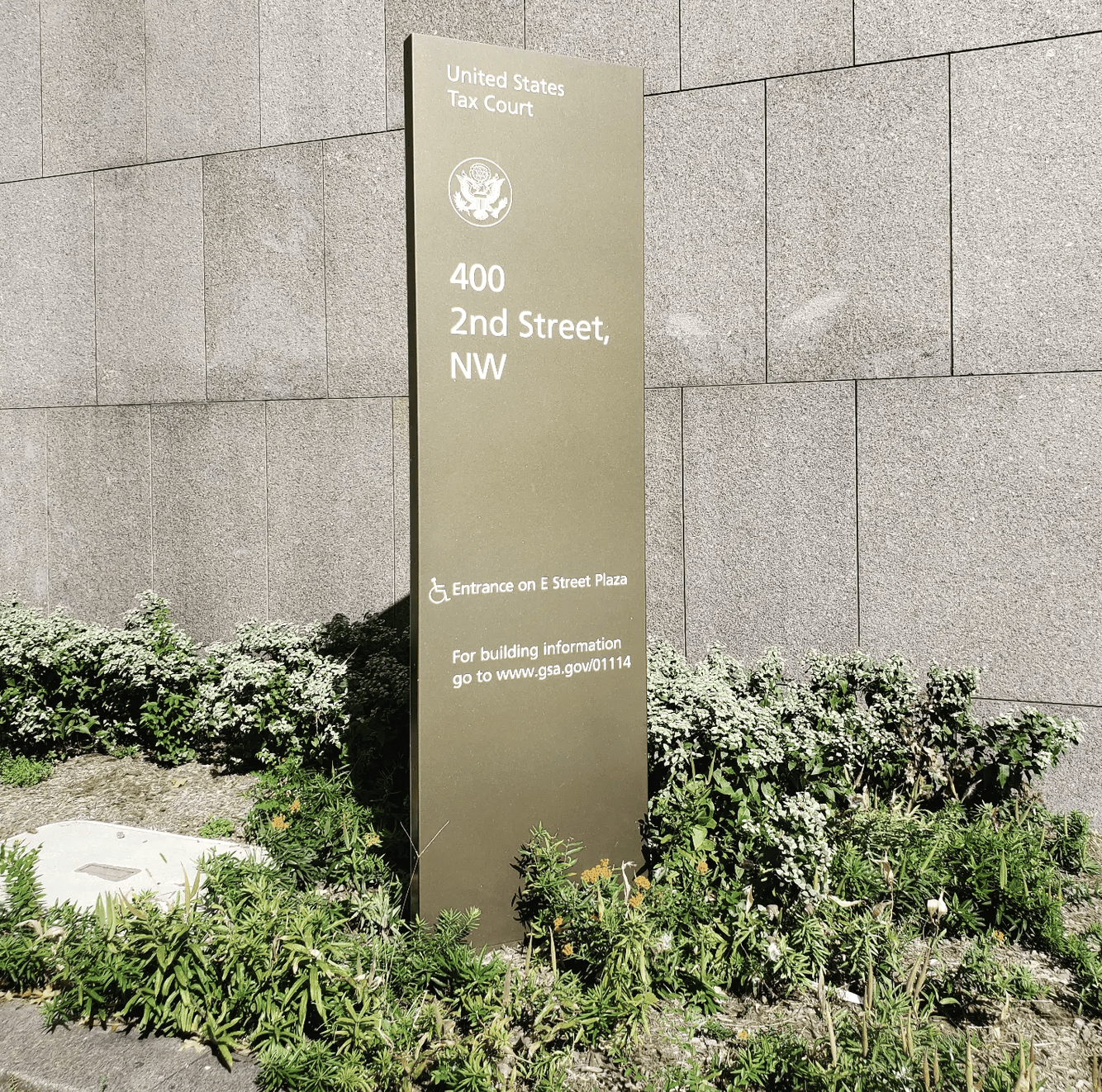
Although the Tax Court is based in Washington, D.C., taxpayers don’t ordinarily have to travel to Washington for trial. And there are no juries. Tax Court judges travel around the country to hear cases.
Tax Court Is Adding Five Trial Cities
Effective September 8, the Tax Court has added five places of trial:
- Austin, Texas
- Charlotte, North Carolina
- Newark, New Jersey
- Orlando, Florida
- Sacramento, California
This brings the total number of Tax Court trial locations to 79. (Importantly, no existing trial location is being eliminated.)
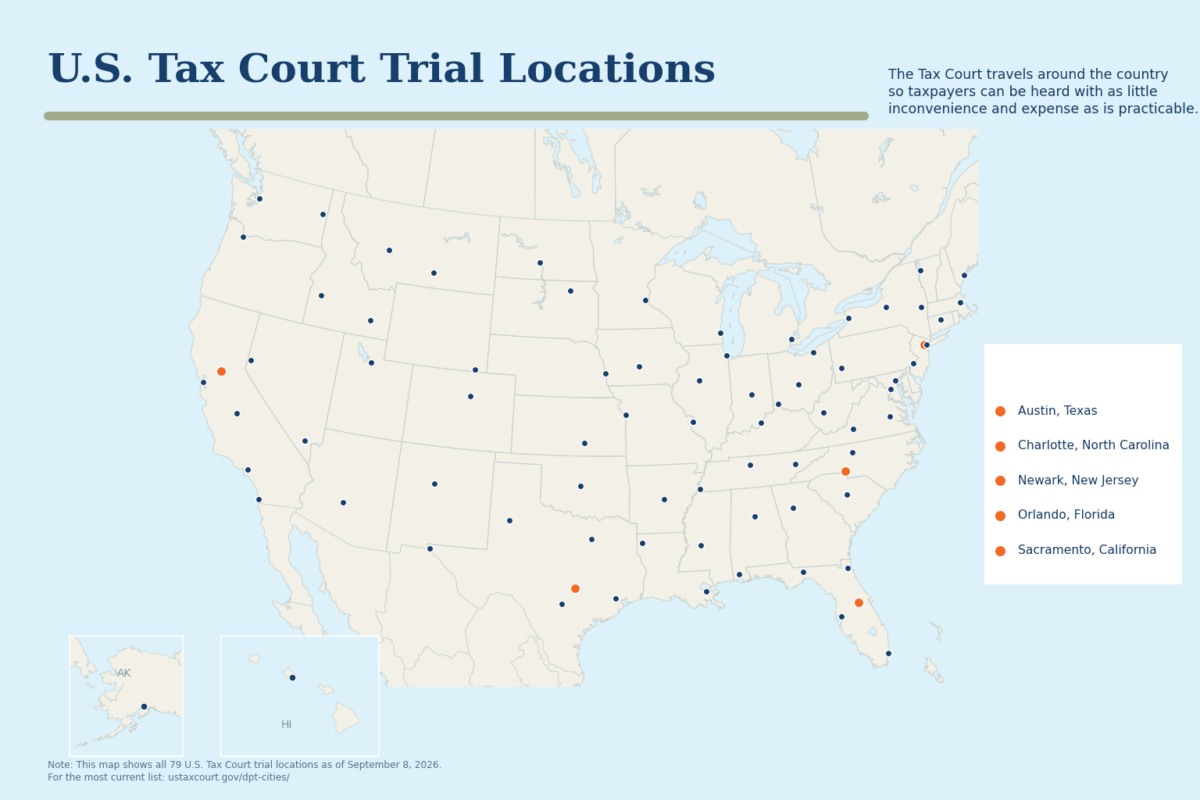
The additions aren’t random. According to the Court, it conducted a data-driven review using information from DAWSON to better align its trial locations with where petitioners lived when they filed their petitions.
That ties in directly with the Tax Court’s mission. Federal law directs the Court to conduct proceedings “with as little inconvenience and expense to taxpayers as is practicable.”
For taxpayers filing new petitions, all five cities are now available as requested places of trial.
The change isn’t limited to new cases. A taxpayer with a pending case who would prefer one of the newly available locations can file a Motion to Change Place of Trial.
Regular Cases Can Now Be Heard Everywhere, Too
Tax Court cases generally proceed as either regular cases or, when eligible, small tax cases—often called “S cases.”
Small tax cases use simplified, less formal procedures and generally move more quickly. But there’s a significant trade-off: you can’t appeal a decision in an S case.
Not every dispute qualifies. For example, in a deficiency case, the amount in dispute generally cannot exceed $50,000 for any one tax year. Other eligible case types have their own $50,000 thresholds.
Until now, some Tax Court trial locations were available for small tax cases but not regular cases. That’s changing.
Beginning September 8, taxpayers with regular tax cases can request any of the Court’s 79 places of trial. In other words, taxpayers will no longer have fewer geographic choices simply because their cases aren’t proceeding under the small-case rules.
The Court will continue to schedule small-case calendars, regular calendars, and hybrid calendars that include both. Taxpayers with pending regular cases can also file a Motion to Change Place of Trial if another location is now more convenient.
A Bigger Experiment Is Coming In 2027
Beginning no earlier than the fall 2027 term, the Tax Court plans to pilot what it calls “reporting calendars.”
Under the Court’s traditional system, cases are placed on a trial calendar. The parties receive a date, time, and place for trial, and the case proceeds toward that date. Most cases ultimately settle rather than go to trial.
A reporting calendar would work differently. Instead of immediately assigning a trial date, the Court would assign the case to a judge and issue a standing scheduling order governing pretrial proceedings. The judge would then set a trial date if necessary.
The Court says the pilot is intended to test whether different calendaring approaches can improve operational efficiency. Traditional trial calendars aren’t going away, and currently scheduled calendars won’t be affected.
There are obvious potential advantages. If many Tax Court cases resolve without trial anyway, assigning a judge and moving pretrial matters along without immediately reserving a trial date could allow the Court to use its trial calendars more efficiently.
But there’s also a potential downside. A trial date is a deadline—and deadlines have a remarkable ability to focus attention. For taxpayers, practitioners, and the government, a looming calendar call can spur the parties to exchange information, narrow issues, stipulate facts, and seriously discuss settlement.
The new approach also raises questions about how it will work for self-represented taxpayers. A specific instruction to appear for trial on a particular date is easy to understand. A longer pretrial process involving a standing scheduling order and a trial date to be determined later (if at all) may require more attention from taxpayers who aren’t accustomed to litigation.
Of course, the point of a pilot program is to see how it will work. The Court says it will provide additional information about reporting calendars before scheduling the first one.
Why The Changes Matter
For taxpayers contemplating a case, there are now more places to be heard. For those already in Tax Court, there’s also a potential opportunity to change trial locations.
For practitioners, the reporting-calendar pilot is worth watching. If assigning judges earlier and trial dates later changes how quickly cases settle—or how efficiently they move through the Court—the experiment could ultimately have implications well beyond the cases selected for the pilot.
And for everyone else, the changes are a useful reminder of something taxpayers don’t always realize about Tax Court: although its courthouse is in Washington, D.C., the Court was designed to come to taxpayers. Now, it’s coming to a few more of them.




Want more Taxgirl?
Get tax news, explainers, deadlines, and more delivered straight to your inbox.
Subscribe →