

2026 vs. 2027 Tax Brackets: What’s Changed, And What Does It Mean For Your Taxes?
The IRS has released the official federal income tax brackets and inflation adjustments for 2027, and my annual roundup has prompted quite a few questions. The one I’ve heard most often? How do the new numbers compare with 2026?
It’s a fair question. After all, inflation affects everything from groceries to utility bills. But how does it affect your taxes? And if the IRS adjusts tax brackets for inflation every year, does that mean you’ll pay less?
The short answer is that the tax brackets are going up, but the tax rates aren’t changing. What that means for your actual tax bill depends on your circumstances.
First, A Quick Look At Inflation
According to the Bureau of Labor Statistics (BLS), consumer prices increased 3.7% over the 12 months ending in September 2026. That’s the latest available reading of the Consumer Price Index for All Urban Consumers (CPI-U), the measure commonly referenced in headlines about inflation. Over the same period, the Chained Consumer Price Index for All Urban Consumers (C-CPI-U) increased 3.5%.
You might have gotten a pay raise to account for the increase in the cost of living. But more pay could bump you into a higher tax bracket even though your overall bottom line hasn’t improved. On paper, it looks like a tax increase even if Congress hasn’t made a single change.
To help taxpayers keep pace, the tax code requires annual adjustments to certain tax items, such as tax brackets, based on inflation. Without those adjustments, what we call “bracket creep” due to inflation would increase tax burdens.
The CPI-U reflects changes in the prices paid by urban consumers for a representative basket of goods and services. But the chained CPI also accounts for how people change what they buy when prices go up.
Here’s an example of how that works:
Let’s say that in 2025, coffee was $10/pound and tea was $10/pound. Because I tend to drink more coffee, I bought 10 pounds of coffee and 2 pounds of tea. In 2026, let’s say coffee jumped to $15/pound and tea went up to $11/pound. Even though I love coffee, let’s say I switched to tea because it was cheaper and bought 5 pounds of coffee and 7 pounds of tea. My bill would have been $172 at the new prices, but the substitutes cost $152. In other words, I’m still spending more than before, but less than I would have spent if I hadn’t changed my buying habits.
In my example, I still bought 12 pounds of caffeinated beverages, but I altered the proportions because of the pricing. The theory is that most folks react similarly—you adjust your spending to compensate for price increases (though, to be clear, this is hypothetical, and I am *not* changing my coffee consumption).
Because of the way it’s calculated, chained CPI generally increases more slowly than traditional CPI over time. And that matters when it comes to federal income taxes.
How Does The IRS Adjust Tax Brackets For Inflation?
Since the Tax Cuts and Jobs Act of 2017, chained CPI has been used to calculate inflation adjustments for many federal income tax provisions, including the tax brackets.
The calculation also uses a different measurement period than the inflation figures we usually see in the news. For annual tax adjustments, the calculation generally uses a 12-month average ending August 31, along with a designated base year. That’s one reason the 3.7% inflation rate reported for September 2026 doesn’t translate directly into a 3.7% increase in every tax provision for 2027.
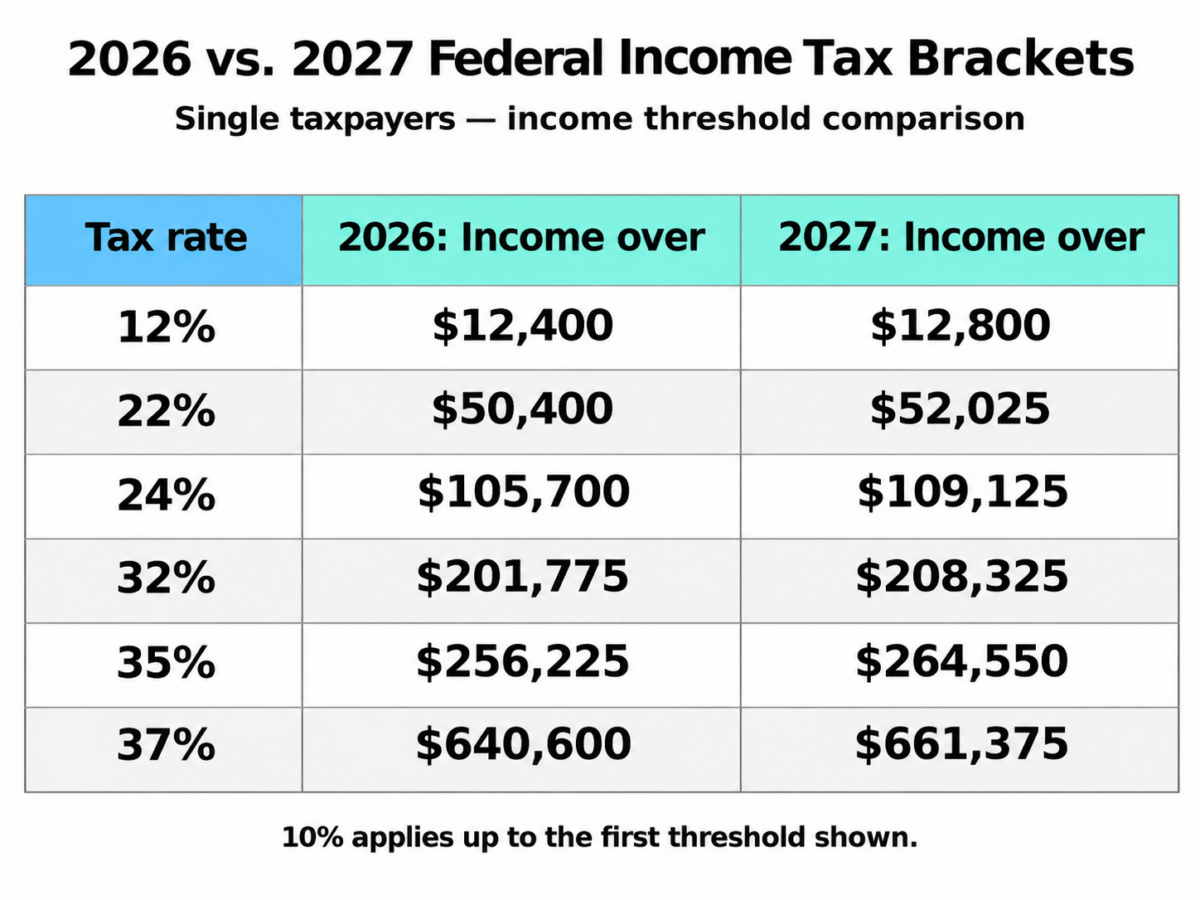
For example, the threshold for the 22% bracket for single taxpayers increases by about 3.2% from $50,400 in 2026 to $52,025 in 2027. That’s not the same as the 3.7% inflation rate reported for September, because the IRS uses a different measurement period and calculation.
Rounding matters, too. Adjusted amounts are rounded down to set dollar increments, so provisions using the same inflation figure can show slightly different percentage changes.
Also, not every provision is adjusted for inflation. Some amounts are fixed by law, while others have special adjustment rules.
And no, the Fed’s interest rate decisions aren’t part of the calculation—though those decisions can affect inflation over time.
2026 vs. 2027 Federal Income Tax Brackets
So what has changed? First, the good news: The seven federal income tax rates remain unchanged for 2027. They’re still 10%, 12%, 22%, 24%, 32%, 35%, and 37%.
What has changed is how much taxable income falls into each bracket. For single taxpayers, here’s how the thresholds compare:
 For married couples filing jointly, the thresholds are:
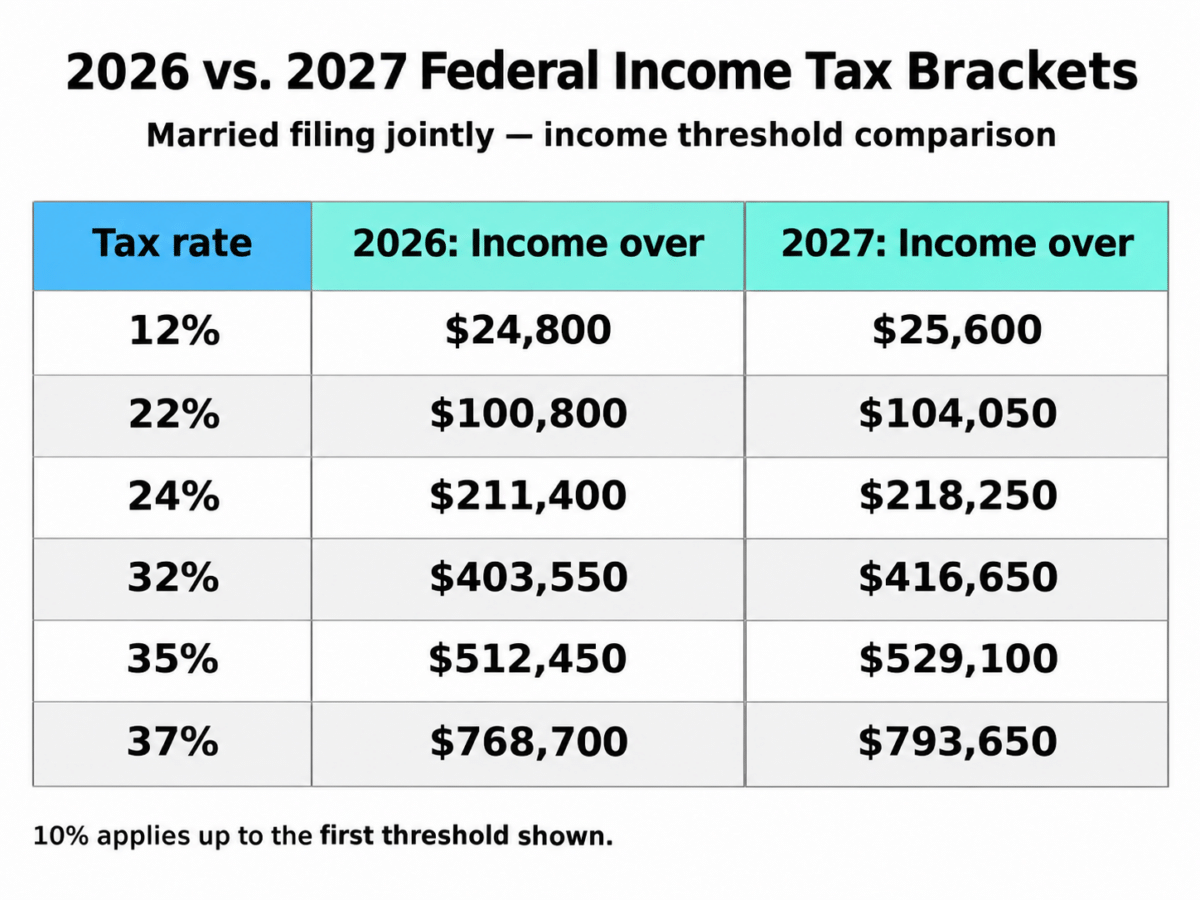
The 10% rate applies to taxable income up to the first threshold shown in each table. The thresholds identify where the next marginal rate begins, not where all of your income becomes subject to that rate (for more on how income tax rates work, check out this previous article).
The Standard Deduction Is Increasing, Too
Tax brackets aren’t the only numbers affected by inflation. The standard deduction also increases for 2027. Here’s how the amounts compare:
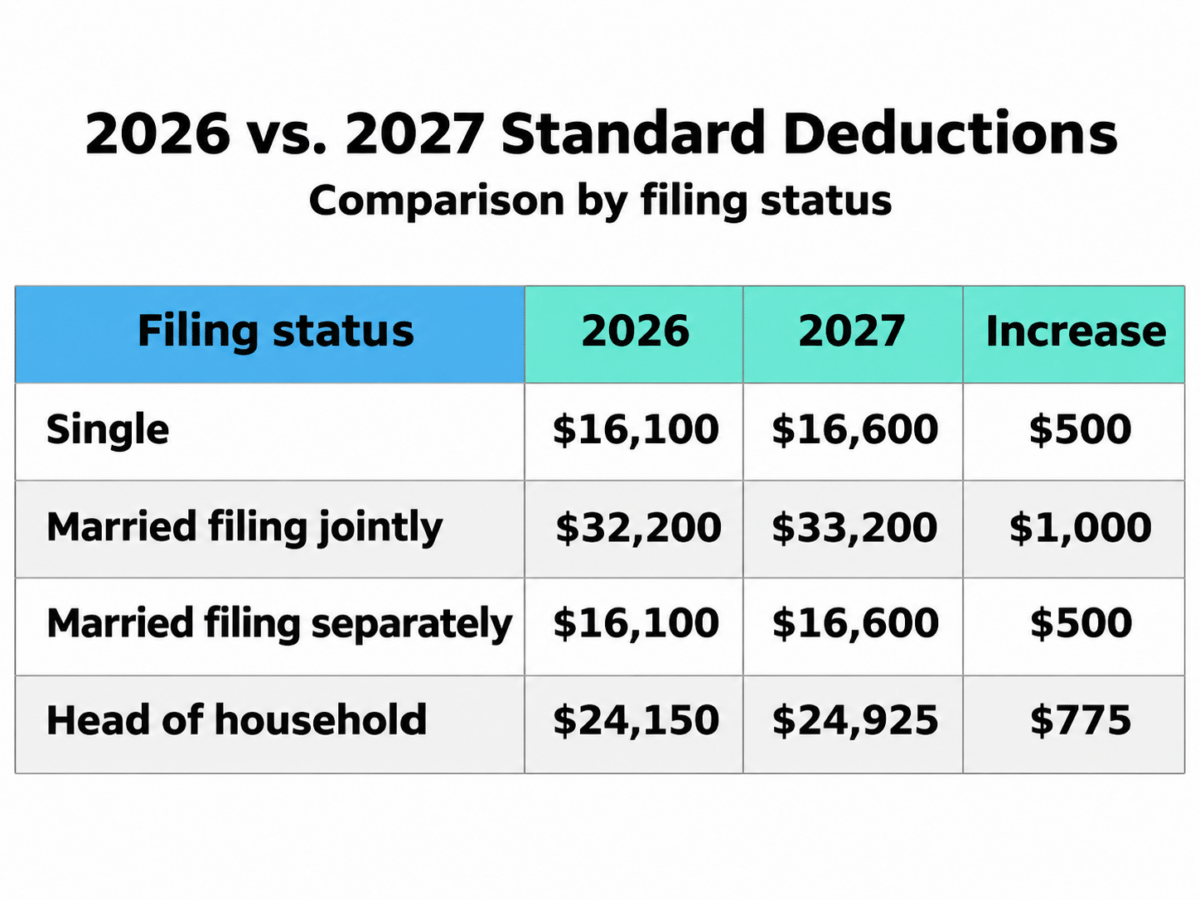
The standard deduction reduces the amount of income subject to federal income tax. So, if you claim it, an increase generally means that more of your income is sheltered from federal income tax.
But don’t confuse a $500 increase in your standard deduction with $500 in tax savings. A deduction is a dollar-for-dollar reduction in taxable income, not a dollar-for-dollar reduction in your tax bill. For someone in a 12% bracket, an extra $500 deduction is worth about $60.
What Else Is Changing For 2027?
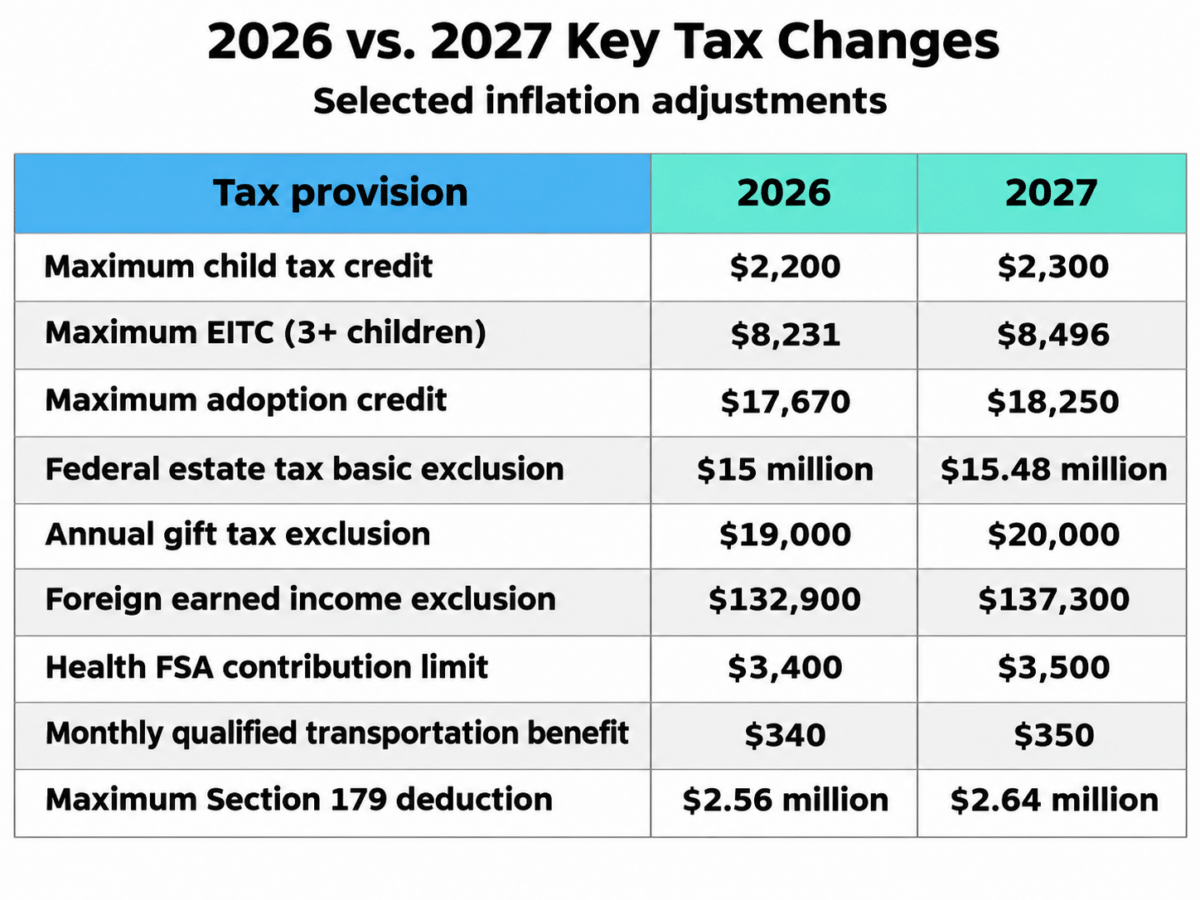
The IRS announced adjustments affecting nearly 70 tax provisions. Here are some of the bigger changes that could matter to taxpayers.
What Does This Mean For Ordinary Taxpayers?
Let’s assume you’re a single taxpayer earning $75,000 in wages in both 2026 and 2027. For simplicity, assume you take the standard deduction, have no other income or deductions, and don’t qualify for any tax credits.
In 2026, you would have $58,900 in taxable income after the $16,100 standard deduction. Based on the 2026 brackets, your federal income tax would be $7,670. In 2027, you would have $58,400 in taxable income after the higher $16,600 standard deduction. Applying the new brackets results in a federal income tax of $7,389.50.
That’s a difference of $280.50, even though your gross income hasn’t changed. It’s largely the result of adjusting the existing tax system to account for inflation.
Of course, that’s a simplified example. Actual tax liability depends on deductions, credits, filing status, other income, and individual circumstances. Wages and expenses don’t necessarily increase at the same rate as inflation.
Will You Actually Pay Less In 2027?
Maybe. But that’s not quite the right question.
The annual inflation adjustments are designed to account for price changes, not necessarily to deliver a new tax cut each year.
The bottom line? Higher tax brackets and deductions can lower your federal income tax bill, even if your income stays the same. But if your wages rise with inflation, those adjustments may simply keep you from paying more in taxes without giving you any real purchasing power. And while the adjustments generally give taxpayers more breathing room, they don’t guarantee that you’ll feel any better off financially.
For the complete 2027 brackets, including every filing status, standard deductions, capital gains rates, credits, and other inflation adjustments, you can find my full 2027 tax roundup here.




Want more Taxgirl?
Get tax news, explainers, deadlines, and more delivered straight to your inbox.
Subscribe →